You Can Take a Boat Right Into the Spray of Europe’s Strongest Waterfall
In northern Switzerland, the Rhine River reaches a stretch of resistant rock that forces the water into a sudden drop. Rather than narrowing into a single chute, the river spreads across a broad ledge before plunging downward. This formation creates the Rhine Falls near Neuhausen am Rheinfall, close to the historic city of Schaffhausen.
The waterfall is about 23 meters (75 feet) high and stretches roughly 150 meters (490 feet) across. During peak summer flow, hundreds of thousands of liters of water surge over the rocks every second. The sound carries across the valley, and a steady mist often hangs in the surrounding air. Instead of forming a narrow vertical stream, the water moves across a wide, continuous curtain that dominates the landscape.
The falls formed after the last Ice Age, when retreating glaciers shifted the course of the Rhine. The river was redirected onto harder rock layers that eroded unevenly over thousands of years.
The Water Surrounds You
The Rhine Falls offers multiple viewing platforms and walking routes that place visitors remarkably close to the water. Boat tours also operate directly within the basin below the cascade. These boats travel through constantly moving water shaped by powerful currents created by the falling river.
Being close to the water completely changes the experience. Mist can coat clothing and skin quickly, depending on wind and position. The sound is deep and continuous, often compared to distant thunder.
A large rock formation stands in the middle of the basin, shaped by thousands of years of erosion and water pressure. Visitors can climb to viewing platforms on this rock, placing them directly within the sound and spray zone of the falls. From this position, the water feels immediate and powerful.
A Waterfall Defined by Volume and Force
The Rhine Falls is widely known for its power rather than its height. In summer, roughly 600,000 to 700,000 liters of water can move through the falls each second, with higher levels possible during periods of heavy rain or snowmelt.
Seasonal changes shift how the waterfall feels. Summer brings the strongest water flow and dense mist clouds. Winter typically reduces the flow and can allow ice crystals to form along rock surfaces and nearby structures. After sunset, lighting systems illuminate the water.
Why This Waterfall Became a Landmark
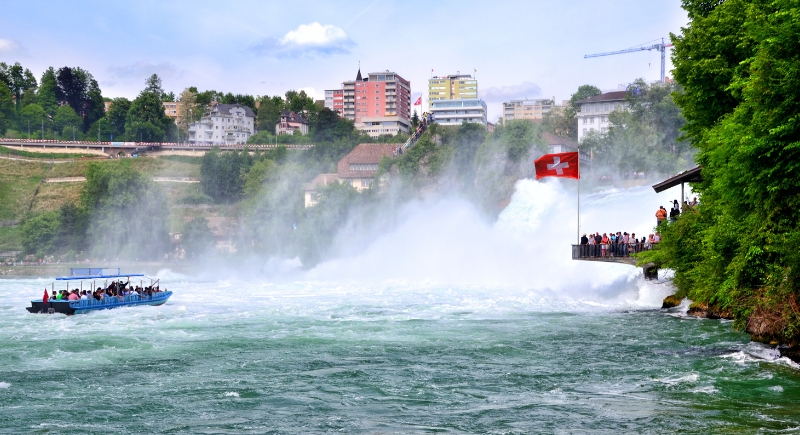
Image via Getty Images/alxpin
The falls are close to towns, rail lines, and major road connections. More than one million people visit each year.
Nearby Schaffhausen developed partly because of the river. Historically, trade routes had to transport goods around the falls, shaping settlement patterns and influencing local industry over time.