Where the 10 Cent Coffee Secret is Still Alive
It may sound strange now, but in 1954 Americans were genuinely upset about paying 15 cents for a cup of coffee. Newspapers even called the debate a “storm in a coffee cup.” The frustration had already started earlier. In 1950, Horn & Hardart raised Automat coffee from a nickel to a dime, and customers felt it immediately. Sales dropped from 70 million cups to 45 million in a year because a dime suddenly felt expensive.
Today, most people think nothing of paying $3 to $6 for coffee, and in some cities a latte can pass $7. Yet along State Route 31 near the southeastern shore of Oneida Lake in upstate New York, there is still a spot where coffee costs exactly what it did when that price first shocked the country: ten cents.
When a Dime Meant Inflation
Image via Canva/Stoica Adrian’s Images
In 1912, a nickel bought a cup of coffee at the Automat in Times Square. That price held for nearly four decades. By 1950, Horn & Hardart was losing 3 cents on every cup sold and finally raised the price to 10 cents. The increase was viewed as a cultural shift, not just a business adjustment.
By 1954, coffee jumped again from 10 cents to 15 cents, a 50% increase that alarmed Americans. Headlines described it as a crisis. At the time, the United States purchased 92% of Latin American coffee exports and 76% of the world’s exportable supply. Coffee was a daily necessity, not a boutique indulgence. A dime once symbolized rising costs. It represented the loss of something affordable.
The Diner That Froze the Price
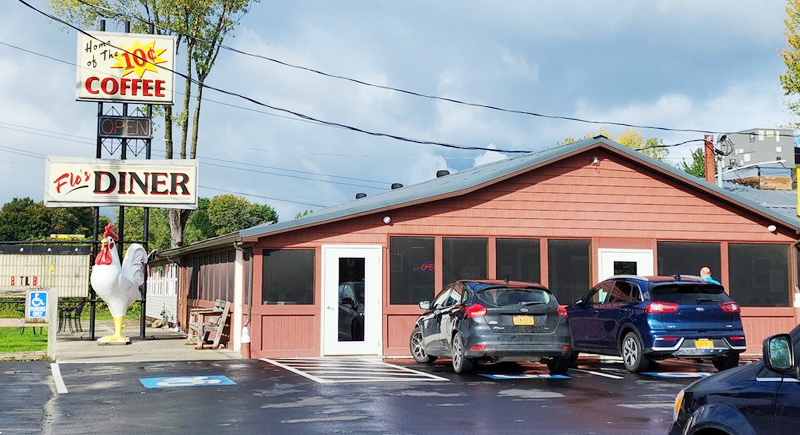
Image via Yelp/Pat O.
Flo’s Diner in the town of Lenox, near Canastota, New York, has served 10-cent coffee since opening in 1976. The price has never changed.
Florence “Flo” Hoch and her husband, Harold, opened the diner after years in the restaurant business. Flo believed no one should leave hungry and everyone deserved an affordable meal out. The 10-cent coffee was part of that philosophy from the beginning.
After Flo passed away in 2011 at age 83, her daughter Sue Hoch Brown publicly committed to keeping the tradition alive. “She started it, and I’m not ending it,” Sue said in a 2025 interview. Nearly 50 years later, the price remains the same.
Cash Only, No QR Codes
Flo’s is located about five miles north of Canastota along Route 31, marked by a roadside sign and a giant rooster statue. It is cash only. The coffee is Paul deLima, ground throughout the day and poured into heavy white mugs. Refills are not allowed, a practical rule when a cup costs a dime.
The diner seats about 100 people, with an average table turnover of 34 minutes. It goes through roughly 100 pounds of coffee a week, or about 15 pounds a day. Some customers come only for coffee. Others eat three meals there daily. Four generations of the Hoch family have worked behind the counter.
Affordable Beyond the Coffee
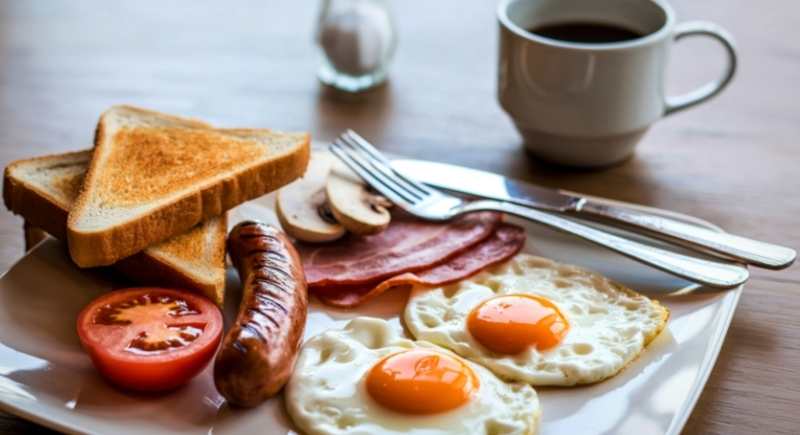
Image via Canva/Carla Tomulescu’s Images
The pricing philosophy extends to the menu. In 2011, dinner for three totaled just over $20. In 2025, a full breakfast including eggs, bacon, sausage, home fries, toast, pancakes, coffee, and a six-inch cookie came in under $15.
The menu runs seven pages. Many items historically sat below $6. Even higher-end entrees rarely exceeded the low teens. The diner once operated 24 hours a day and now opens daily from 8 a.m. to 9 p.m., closing only on Christmas. A competitor once tried offering 5-cent coffee during a brief “coffee war,” but that business did not survive.
Why the Dime Still Matters
In 1924, restaurateurs were already losing money selling 5-cent coffee. By 1950, 10 cents felt expensive. By 1954, 15 cents triggered a national alarm.
Today, coffee often costs more than a gallon of gasoline did in the 1960s. Inflation has reshaped expectations, normalized higher prices, and shifted coffee into a lifestyle purchase rather than a simple beverage.
But at Flo’s, a dime still buys a cup. The coffee is not artisanal, and there is no latte art. What you get is a hot mug, quick service, and conversation from someone who likely knows your name.
In 1950, 10 cents marked the end of cheap coffee. In Lenox, New York, today, it marks something else entirely: a refusal to let everyday affordability disappear.