This Railway Is the Steepest in the World, and It Wasn’t Built for Tourists
In the Swiss Alps, the Stoosbahn funicular opened in late 2017 to replace a 1933 rail line. Its main job was moving residents and workers between the valley and the car-free mountain village of Stoos. The village is about 1,300 meters above sea level, which made road expansion difficult and expensive.
Instead of expanding car routes, planners focused on reliability and capacity. This resulted in the steepest funicular railway on Earth, reaching a gradient of 110 percent, or about 47.7 degrees. This project solved a logistics problem tied to daily life in a mountain community.
The Engineering That Makes The Climb Possible
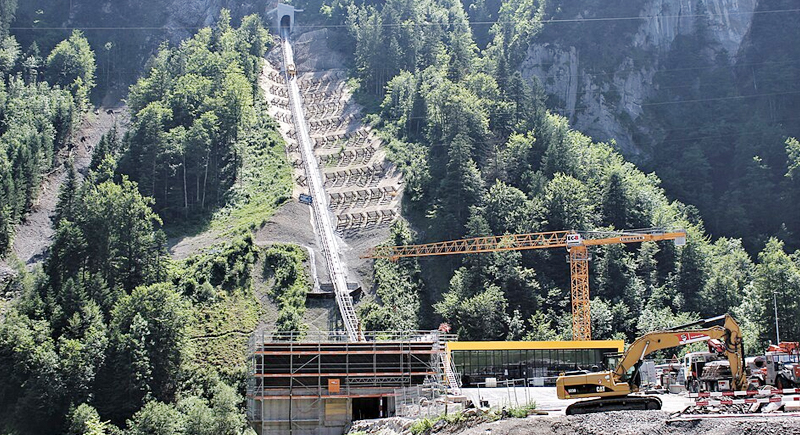
Image via Wikimedia Commons/Pakeha
The line stretches about 1,740 meters and gains roughly 744 meters in elevation. The route passes through three tunnels and crosses two bridges during a trip lasting between four and seven minutes. Keeping the passengers level during that climb required a creative cabin design.
The rail cars use rotating cylindrical cabins that automatically adjust angle as the track steepens, and the floors remain horizontal even when the rail tilts dramatically. Behind the scenes, the drive system uses two low-voltage motors rated at 1.2 megawatts each. Combined output reaches about 2.4 megawatts, similar to powering around 250 escalators at once. That level of output helps maintain smooth movement during extreme incline sections.
Why The Ride Became Famous
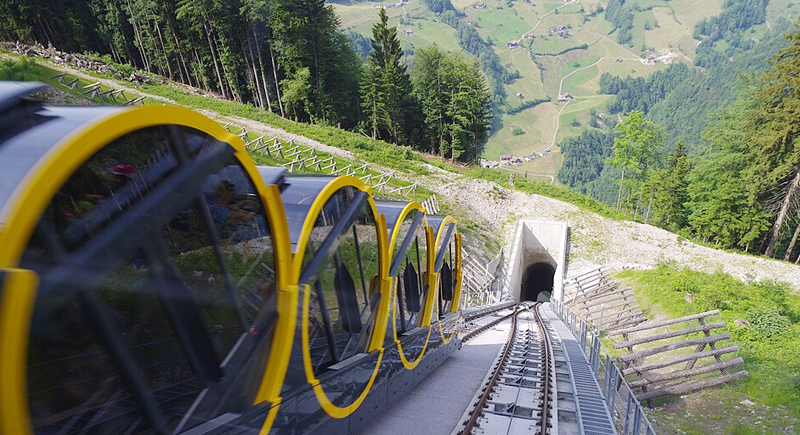
Image via Wikimedia Commons/Nix-dorf
Global attention followed the opening because the steepness set world records. Travel media and social platforms turned the railway into a must-ride attraction. Still, daily use remains essential for local movement. The rail line connects the Schwyz valley area to Stoos, helping move visitors, workers, and supplies. Swiss Travel Pass programs even include access, thereby increasing visitor numbers without altering the railway’s original purpose. The system runs year-round except during maintenance periods.
What Waits At The Top Keeps The Traffic Coming
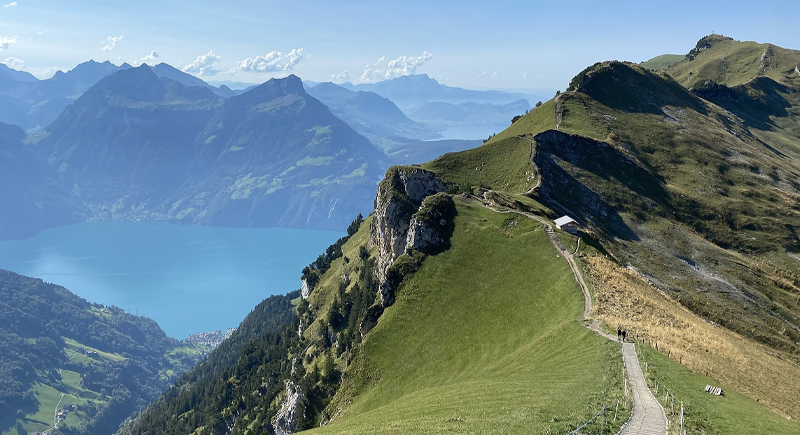
Image via Wikimedia Commons/Silibruno
Stoos offers hiking, skiing, and ridge-walking routes across Central Switzerland’s Alpine terrain. The ridge trail connecting Klingenstock and Fronalpstock delivers views across multiple lakes and mountain ranges. Winter brings about 35 kilometers of ski and snowboard terrain, plus snowshoe and sled routes.
Nearby areas also add variety. The Muota Valley hosts the Hölloch cave system, one of Europe’s largest known cave networks, with more than 200 kilometers of explored passages. The nearby resort village of Morschach adds lake views and trail networks tied to Lake Lucerne tourism.
Getting There Shows How Integrated Swiss Transport Can Be
Travelers typically reach Schwyz by train, then transfer to a bus for a 20-minute ride to the valley station. Drivers can reach the station via the Muotathal road, where ample parking accommodates year-round demand.
Air connections typically route through Zurich Airport, about 54 kilometers away. Basel and Mulhouse airports are located farther out, each roughly 110 kilometers distant. These connections help maintain steady passenger numbers throughout the year.