This Ordinary Street in Amsterdam Turned Into a Perfect Natural Tree Tunnel
Lomanstraat is in Amsterdam’s Oud-Zuid district, part of an early 20th-century expansion formed by architect Hendrik Petrus Berlage under the Plan Zuid. Wide streets, red brick buildings, and long rows of trees are common throughout the neighborhood, but on Lomanstraat, those same elements came together in a way that feels completely different from the rest of the city.
Along this stretch, London plane trees planted more than a century ago reach toward each other until their branches connect above the street. The whole road ends up looking like a natural tunnel, with a shape that feels surprisingly neat and balanced.
With each season, it gives you a different sight to see: spring and summer bring a dense green canopy that filters light across the pavement, fall turns the tunnel into a corridor of gold, and winter strips everything back to bare branches. Despite its growing fame, Lomanstraat remains a residential street. There’s no heavy tourist traffic, no major attractions nearby. People mostly find it by accident, then stop in their tracks.
Why The Trees Started Leaning Inward
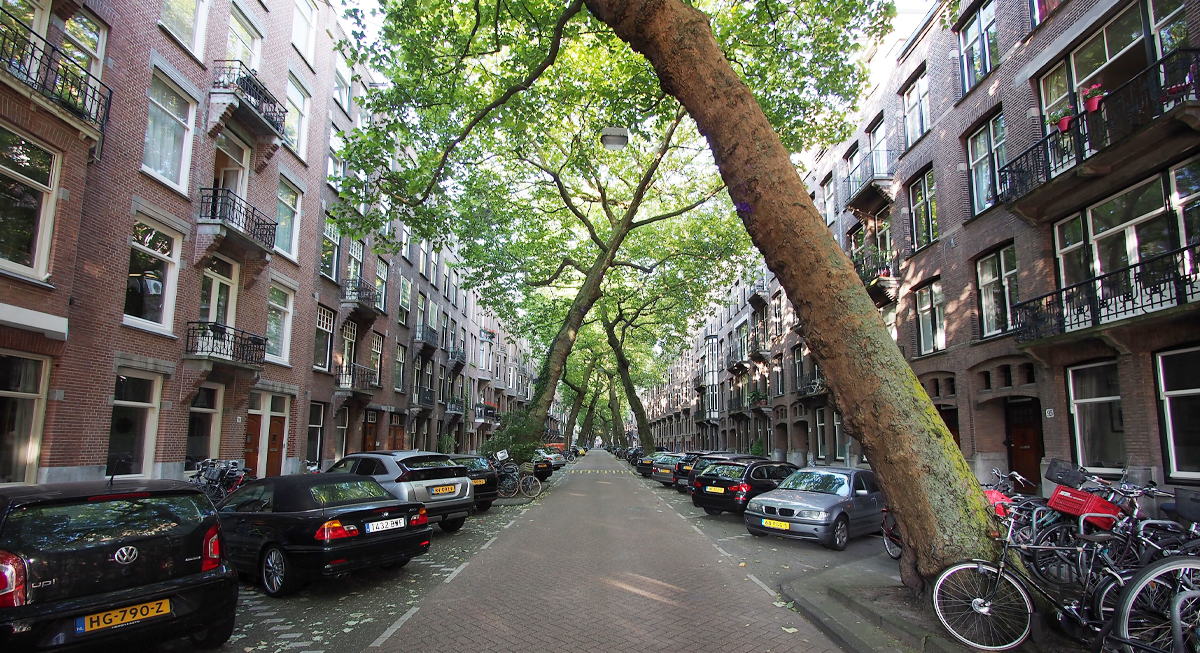
Image via Wikimedia Commons/Alf van Beem
Ask a tree specialist, and the answer is simple: the trees didn’t start out leaning, but adjusted over time. Tall buildings on both sides block direct sunlight for most of the day. The brightest point is above the center of the road, and as the trees matured, they grew toward that light source. Decades of gradual movement pulled the trunks inward until the branches eventually met.
Experts who’ve studied the site have confirmed that the trees are stable and healthy. Their roots remain strong, and there’s no structural risk tied to their unusual shape. What looks carefully designed is, by this account, just a slow reaction to limited sunlight.
A Design That Might Not Be Accidental
There’s another version of the story that refuses to fade. According to local accounts passed down over generations, shaping trees into arches wasn’t unusual in the early 1900s. City planners and gardeners sometimes guided young trees as they grew, bending and training them to create structured avenues.
Under that lens, Lomanstraat stops looking like a coincidence. The trees line up too neatly, and the arch feels too consistent across the entire street. If they were guided early on, the tunnel becomes less of a surprise and more of a long-term project that paid off decades later.