This Breathtaking Underground Crystal Cave Will Actually Boil You Alive
More than 900 feet beneath a mountain in northern Mexico, there’s a hidden chamber that almost doesn’t look real. Massive, glass-like crystals stretch in every direction, some as long as a city bus. When you first see it, it feels unreal, like something designed for a movie set. This place is known as the Cave of the Crystals, and its beauty is hard to put into words.
But stepping inside is not like visiting a normal cave. The heat builds fast and hits hard. Within minutes, your body starts to struggle. The same underground space that leaves scientists in awe can quickly overwhelm anyone who enters. Down there, the heat is not just intense. It is genuinely dangerous.
Discovered by Accident
The cave lies about 984 feet (300 meters) below the Sierra de Naica in Chihuahua. It was discovered in 2000 by miners Pedro and Juan Sanchez after the Peñoles Mining Company pumped groundwater out of a tunnel in the Naica Mine.
When the water drained, they stepped into a chamber lined with massive selenite crystals, a transparent variety of gypsum. The sight was unlike anything previously documented.
Some of the largest crystals measure up to 36 feet, or 11 meters, long and about 3.2 feet, or 1 meter, thick. Many are large enough to walk across. You cannot wrap your arms around them. The chamber itself rises roughly two stories high and stretches to about the size of a football field.
How the Giants Grew
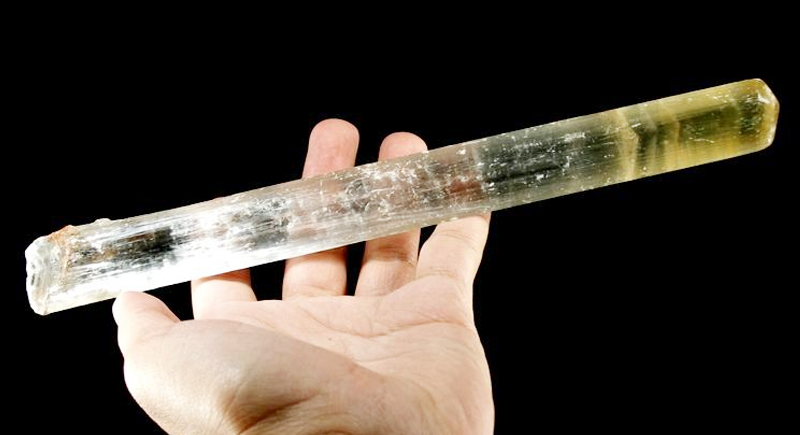
Image via Wikimedia Commons/Robert M. Lavinsky
These crystals formed under remarkably specific conditions. Around 26 million years ago, magma intruded beneath the Sierra de Naica along regional fault lines. That magma heated mineral-rich groundwater trapped in deep underground limestone cavities.
For hundreds of thousands of years, the water temperature remained near 136°F, or 58°C. At that temperature, the mineral anhydrite dissolved and re-formed as gypsum. Because the cave stayed submerged and the temperature remained stable within a narrow range, selenite crystals grew slowly and continuously.
A 2011 study estimated that forming a single selenite crystal just 3.2 feet wide could take between 500,000 and 900,000 years. Over time, uninterrupted growth allowed the cave’s crystals to reach extraordinary sizes.
A Furnace Beneath the Mountain
The same heat that enabled crystal growth now makes the cave hostile to humans. Air temperatures inside have been recorded between 113°F (47°C) and 136°F to 150°F (58°C to 65°C) in some areas. Humidity ranges from 90% to nearly 100%.
Under those conditions, sweat cannot evaporate effectively. The body loses its primary cooling mechanism, and internal temperature can rise rapidly. Heat stroke becomes a serious risk within minutes. Researchers have also warned that prolonged exposure to extreme humidity may cause fluids to condense in the lungs.
Initial exploration attempts were limited to about 10 minutes each. Later, specially designed cooling suits extended visits to roughly 30 minutes. Even with ice-packed vests, helmet cooling systems, and respirators supplying chilled air, scientists operated at the edge of survivability.
The Expedition That Nearly Went Too Far
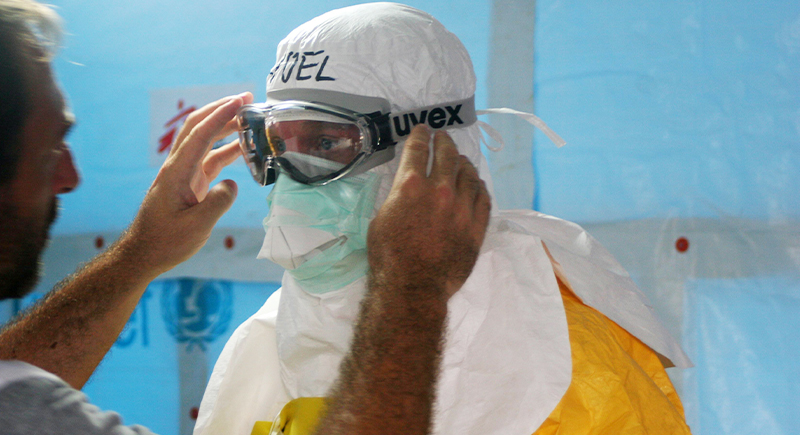
Image via Pexels/CDC
Astrobiologist Penny Boston, director of the NASA Astrobiology Institute, entered the cave in 2008 and 2009 wearing a suit that included an ice vest and a breathing system that forced air across frozen cylinders. Despite that protection, she and her team were not supposed to remain inside longer than half an hour.
On one occasion, Boston stayed close to 50 minutes. She later described the decision as a serious mistake that nearly cost her life. In that environment, even small miscalculations can have immediate consequences.
Life Inside the Crystals
Scientists were willing to accept those risks because the cave holds more than a geological spectacle. Boston’s team discovered microbial life forms trapped inside tiny pockets within some crystals. Suspended in air bubbles, certain microorganisms may have remained dormant for tens of thousands of years.
These extremophiles survive without sunlight and draw energy from minerals rather than organic matter. Studying them helps researchers understand how life can persist in extreme environments on Earth.
It also informs the search for life on icy moons such as Europa, where liquid water may exist beneath frozen crusts.
Sealed Off Again
In 2017, the mining company stopped pumping water from the Naica Mine, allowing groundwater to refill the cave. Submerging the crystals again may help protect them from structural damage caused by prolonged exposure to air. It also makes the cave inaccessible.
The Cave of the Crystals remains one of Earth’s most extraordinary natural chambers. It is also one of the least forgiving. Beneath the mountain in Chihuahua, geology built something breathtaking.