This Breathtaking Monastic Library Holds 160000 Medieval Texts
There are grand libraries, and then there is the Abbey Library of St. Gallen. Inside a Benedictine monastery in eastern Switzerland, this Baroque masterpiece holds around 160,000 volumes, including some of the most important medieval texts in Europe. The moment you take it in, you realize this is not just another historic building.
You step through its carved doorway and find yourself surrounded by more than books. This space has protected knowledge for over 1,300 years, and you can feel the weight of that history the instant you enter.
A Library Born in the Early Middle Ages
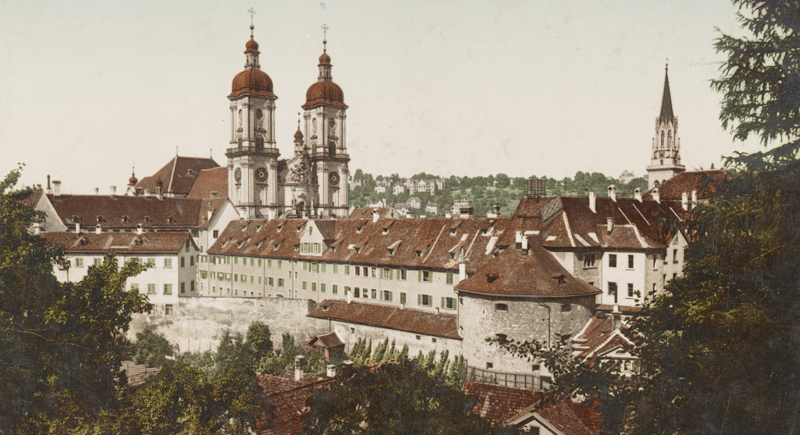
Image via Wikimedia Commons/Photoglob Co., publisher
The origins of the abbey trace back to the early 7th century, when the Irish missionary Saint Gall established a hermitage on this site. By around 820 CE, architectural plans already showed a library attached to the main church. The monastery followed the Rule of St. Benedict, which encouraged study and literacy. From the beginning, books were not decorative. They were central to monastic life.
Over time, St. Gallen developed into one of the leading intellectual centers of medieval Europe. By the 10th century, it was known for its illuminated manuscripts and scholarship in theology, music, law, astronomy, grammar, and medicine. The library became both a religious and educational institution, and it has continued collecting ever since.
The Baroque Hall That Stops You in Your Tracks
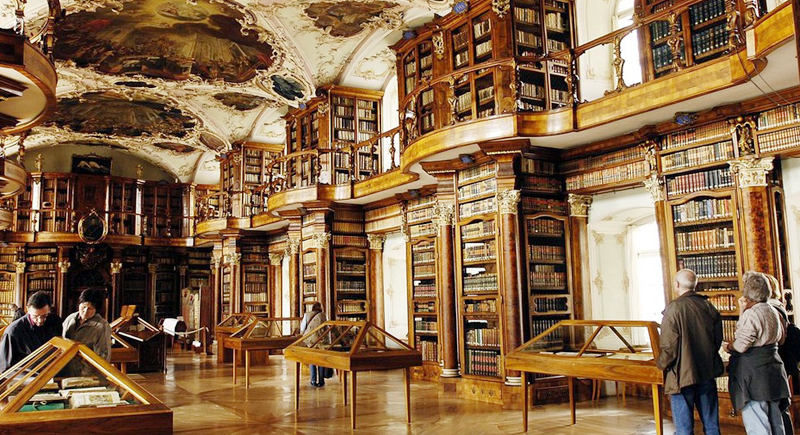
Image via Wikimedia Commons/Martin Thurnherr
The current library hall was completed in 1767, designed by architect Peter Thumb in an ornate Rococo style. Inside, walnut wood floors are patterned with star motifs dating back to the 18th century. Visitors must wear soft felt slippers to protect the historic surface. Even tripods are fitted with protective coverings.
Look up, and you will see ceiling frescoes painted by Josef Wannenmacher. They depict the four major Christian councils: Nicaea (325), Constantinople (381), Ephesus (431), and Chalcedon (451). Between them appear Church Fathers, angels, and decorative scrollwork designed by the Gigl brothers.
Carved wooden galleries curve along the walls, and balconied gantries frame rows of leather-bound volumes. Above the entrance, a Greek inscription reads “Psyches Iatreion,” meaning “Healing place of the soul.” The phrase captures both the spiritual and intellectual ambition of the space.
What 160,000 Volumes Really Means
The library’s holdings total around 160,000 manuscripts and early printed works. Among them are more than 2,100 medieval codices, including roughly 400 written before the year 1000. That makes it one of the richest surviving collections of early medieval texts anywhere in the world.
The collection includes the Codex Sangallensis 51, also known as the Irish Gospels of St. Gall, one of the oldest Latin Gospel manuscripts in Western Europe. It also holds one of the largest assemblages of Irish manuscripts on mainland Europe, brought by pilgrims traveling through the region in the early Middle Ages.
Scholars also value the library’s Old High German manuscripts, which preserve some of the earliest written examples of the German language. Carolingian-era works by Augustine, Ambrose, Gregory the Great, and Isidore of Seville line the shelves. The library even preserves one of the earliest known architectural plans drawn on parchment, the famous Plan of St. Gall.
Survival Against the Odds
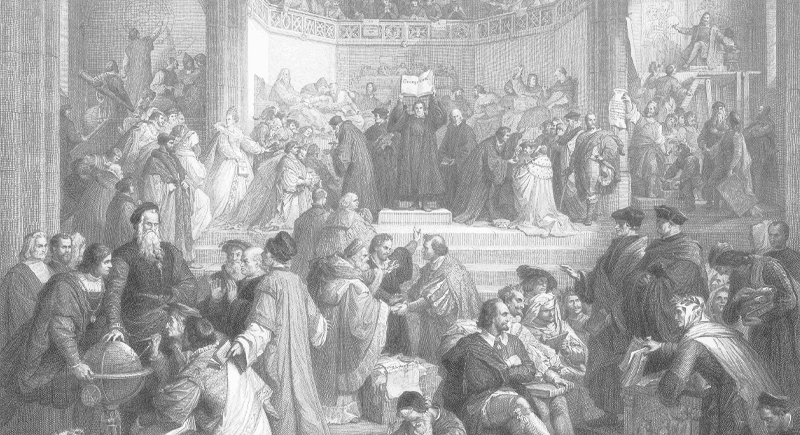
Image via Wikimedia Commons/ONAR
What makes the Abbey Library of St. Gallen even more extraordinary is not just what it contains, but that it survived. While monasteries across Europe were dissolved during the Protestant Reformation and later political upheavals, St. Gallen’s collection was carefully protected.
Even between 1797 and 1805, when the abbey itself was dissolved, the manuscripts were guarded and transferred by Catholic authorities in the newly formed Canton of St. Gallen. Many of the books remain in the same place where they were originally copied, studied, and preserved centuries ago.
In 1983, the Abbey District of St. Gallen was designated a UNESCO World Heritage Site, recognizing both its architectural and cultural importance. Today, roughly 190,000 visitors pass through its doors each year.
A Sanctuary That Still Breathes
Despite its age, the library is not a museum frozen in time. It remains a working research institution. Scholars continue to consult its manuscripts, and the abbey still functions as a cultural landmark in modern Switzerland.
If you walk across the creaking walnut floor in your felt slippers, you will realize something rare has endured here. In an era of digital archives and artificial intelligence, this monastic hall remains a living archive of medieval thought.