This Abandoned Arizona Town Has Been Frozen in the 1950s Forever
In 1950, a huge open-pit copper mine opened beside a small town in Arizona. As the mine expanded over the next two decades, large parts of the community were cleared away to make room for it. Mining finally stopped in 1974 when copper was no longer profitable.
What remained was never fully rebuilt. Just five minutes from Bisbee, Lowell still looks like a small American town from the 1950s that time forgot.
A Town Built on Copper
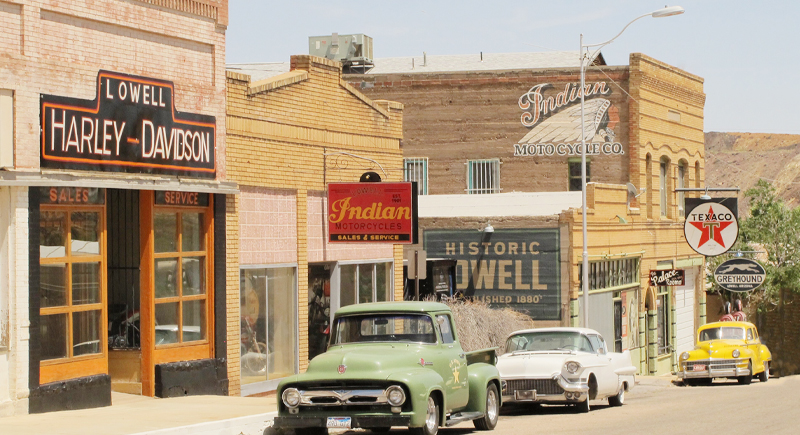
Image via Wikimedia Commons/Packbj
Lowell began around 1880 during Arizona’s copper boom and grew alongside nearby Bisbee. By the late nineteenth and early twentieth centuries, Bisbee ranked among the world’s largest copper producers. Lowell served as housing for miners and their families. Immigrants from Serbia, Finland, Montenegro, and other parts of Europe settled in the town and built a working-class community centered on Erie Street.
The town was incorporated into Bisbee in the early 1900s, though many locals held onto their Lowell identity. At its peak between the 1920s and 1940s, Erie Street served as a busy main drag lined with shops and services that supported daily life in a mining town. Then the ground started disappearing.
The Mine That Swallowed a Town
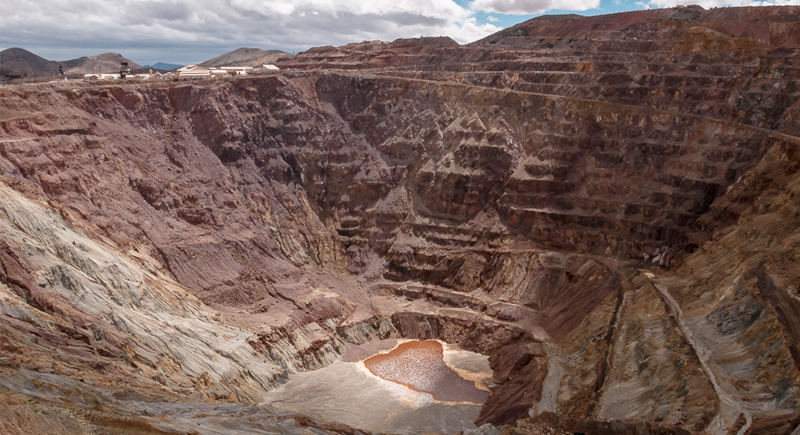
Image via Wikimedia Commons/StellarD
The Lavender Pit opened in 1950 and expanded aggressively through the 1950s and 1960s. Named after mining engineer Harrison Lavender, it grew to roughly 300 acres and reached a depth of about 900 feet. Over its lifetime, the mine produced an estimated 86 million tons of ore containing copper and other metals.
As the pit expanded, homes and buildings were demolished, and the operation consumed large portions of Lowell. By the 1970s, after copper prices fluctuated and extraction costs climbed, the mine shut down in 1974. By then, Lowell had largely emptied, but Erie Street survived, and that accident of geography created something rare.
Erie Street’s Time Lock
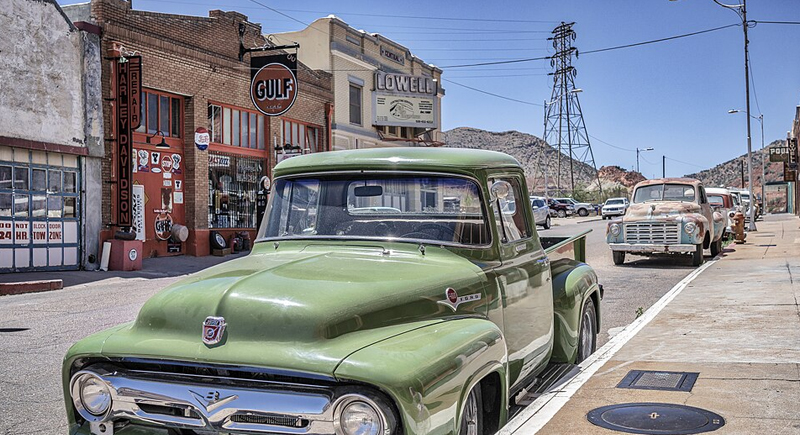
Image via Wikimedia Commons/Mobilus In Mobili
Today, Erie Street feels like it sits somewhere between 1945 and 1959. Old storefronts line the road, including a diner, a hardware store, and a vintage Shell gas station. Classic American cars remain parked along the curb, with chrome trim and tailfins that defined postwar design. Chevrolet, Cadillac, and Dodge models appear throughout the street. Their faded paint and worn surfaces add to the sense that they have been there for decades.
The Shell station stands out as the street’s focal point. The original building once served miners and local residents. Restoration efforts, supported by fundraising in 2021, revived its yellow and red branding and installed vintage gas pumps. Today it serves as a tribute to mid-century car culture rather than a working fuel stop.
A Greyhound bus also rests on Erie Street. It was not originally part of Lowell, but it was brought in by the Lowell Americana Project as a symbol of 1950s cross-country travel. In that era, long-distance bus trips were common, and the bus fit seamlessly into the scene.
Preservation With Purpose
Lowell is often called a ghost town, though people still live in the surrounding area under Bisbee’s jurisdiction. What remains of the town includes Erie Street, Evergreen Cemetery, Lowell Middle School, and the Saginaw subdivision.
The Lowell Americana Project has played a central role in preserving and shaping Erie Street as a living museum. The project has added vintage signage, period cars, and artifacts to reinforce the mid-century character. Car shows and retro-themed events attract visitors who care about classic vehicles and American history.
A few businesses operate there, including the Bisbee Breakfast Club, which has been open since 2005 and adds a working diner atmosphere to the preserved strip.