There Are Secret Airports in the Middle of the Ocean and You Had No Idea
Some of the world’s busiest airports operate on artificial islands built entirely offshore to solve practical constraints. As cities expanded and available land disappeared, aviation planners needed space for longer runways, noise buffers, and future growth. Building at sea allowed airports to reduce urban noise, avoid physical barriers, and design runways without geographic limits. Despite the engineering cost and risk, offshore airports proved efficient enough to become critical hubs handling tens of millions of passengers each year.
Kansai’s Bold Experiment
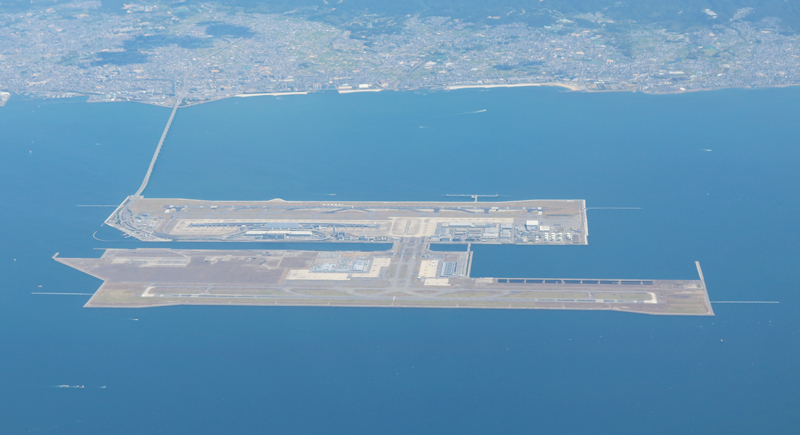
Image via Wikimedia Commons/Ankou1192
The modern offshore airport story begins with Kansai International Airport. It opened in 1994 and operates on a manmade island in Osaka Bay. The island exists because overcrowding near Osaka made expansion impossible. Construction required years of seabed reinforcement, seawalls, and constant monitoring.
The terminal stretches over one mile, still the longest airport terminal on the planet. Kansai handles tens of millions of passengers each year while sitting on land that slowly sinks. Engineers track the movement continuously and reinforce defenses as needed. Constant maintenance is part of the design.
Hong Kong Took It Further
Hong Kong followed with scale and precision. Hong Kong International Airport replaced the famously dangerous Kai Tak Airport and reshaped the region’s air traffic overnight. Chek Lap Kok merged two islands and reclaimed the surrounding seabed to form a massive aviation platform. Two parallel runways support long-haul traffic across Asia, Europe, and North America. Passenger volume regularly exceeds 70 million per year.
Japan Did It Again, Quieter This Time
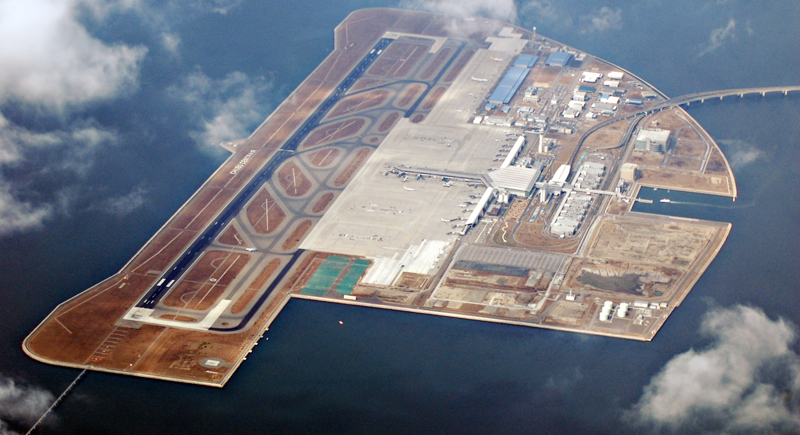
Image via Wikimedia Commons/Aaron Headly
Near Nagoya, Chūbu Centrair International Airport shows how offshore airports evolved after Kansai. Engineers applied lessons about subsidence and environmental impact. The island features advanced marine monitoring systems and a more compact layout. Centrair gained recognition for service quality and efficiency.
Korea’s Hybrid Approach
Not every oceanic airport floats far from shore. Incheon International Airport is located on reclaimed land between islands west of Seoul. Its location reduces congestion near the capital while allowing massive expansion. Incheon built its reputation on speed and comfort. Baggage moves quickly, connections run smoothly, and the ocean presence fades into the background, even though it made the entire layout possible.
China’s Next Leap
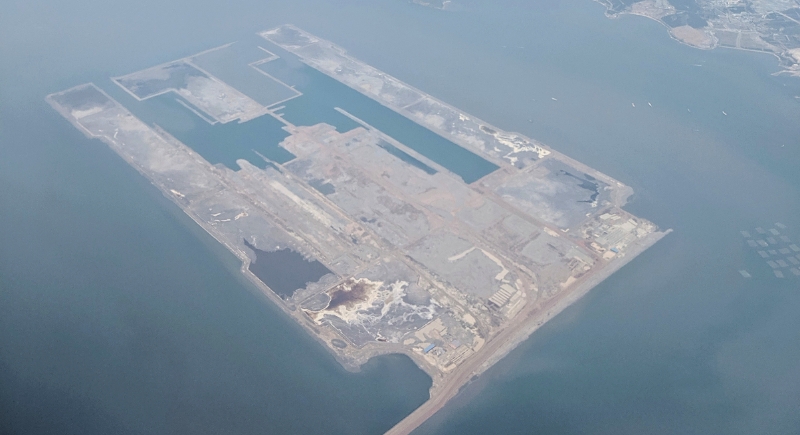
Image via Wikimedia Commons/Temptation115
China now plans to push the concept to its limits. Jinzhou Bay International Airport is under construction on a 20-square-kilometer artificial island off the northeastern coast. Plans include four runways and a terminal covering nearly one million square meters. The projected capacity is 80 million passengers annually, with opening targets in the mid 2030s. Engineers face complex seabed conditions, deep drilling challenges, and tight timelines.