The Sad Story Behind Switzerland’s Most Iconic Abandoned Hotel
At 7,969 feet (2,429 meters) above sea level, on a sharp hairpin bend of the Furka Pass, stands one of the most photographed buildings in the Swiss Alps: the Hotel Belvédère. Built in 1882 during the Belle Époque, the stone hotel was designed to face the Rhône Glacier directly. At the time, the ice flowed dramatically down toward the valley, practically within reach of its terrace.
However, today, the glacier is no longer visible from the hotel, and that disappearance tells you almost everything about what went wrong.
Born in the Golden Age of Alpine Tourism
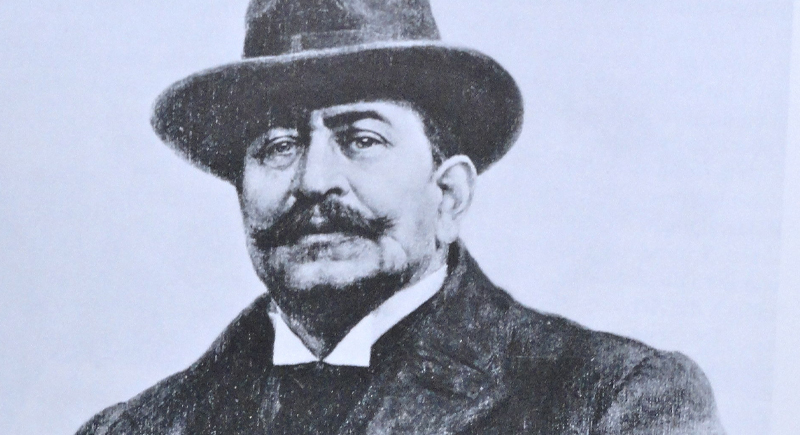
Image via Wikimedia Commons/Adrian Michael
The Hotel Belvédère was commissioned by hotelier Alexander Seiler, one of the driving forces behind 19th-century Swiss tourism. During the late 1800s, Switzerland was experiencing a hotel boom. In Valais alone, the number of hotels grew from 79 in 1880 to 321 just before World War I. By 1914, more than 3,500 hotels were operating across the country.
The Belvédère was part of that expansion. It was positioned precisely in the second bend of the Furka Pass road and offered panoramic views of the Valais and Bernese Alps. It could accommodate up to 90 guests at its peak. Running water and electric lighting made it one of the region’s most modern buildings.
Its main attraction, however, was the glacier. Tourists came not just to sleep in a mountain hotel but to witness a natural spectacle that felt eternal. Clearly, it was not.
When Roads Create Tourism — and Destroy It
Image via Getty Images/Pramote2015
The Furka Pass was a crucial alpine crossing for decades. Stagecoaches, then rail connections, brought multi-day travelers who stayed overnight in Gletsch and along the pass. Tourism followed transportation, but transportation evolved.
After World War II, private automobiles changed travel behavior. Visitors no longer needed to stay overnight. The Furka became a scenic drive rather than a destination. The opening of the Furka Base Tunnel in 1982 diverted rail traffic entirely from the pass, further isolating the region.
Fewer overnight guests meant fewer viable hotels. One by one, they closed. The nearby Hotel Furka was demolished in 1982. Others fell into disrepair. The Belvédère survived but barely.
The Glacier That Moved Away
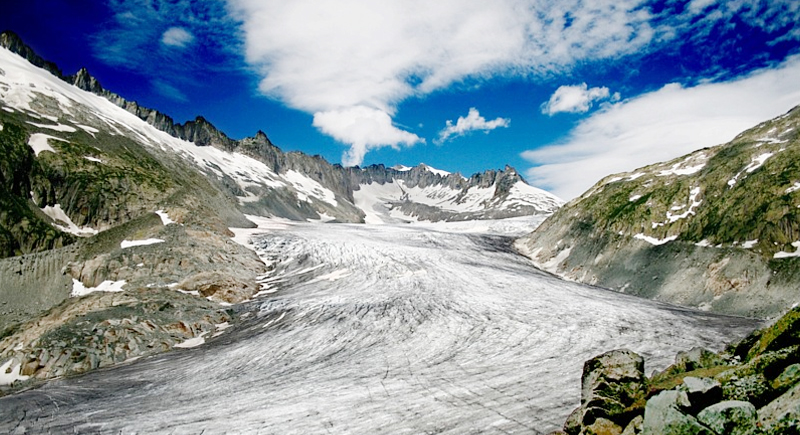
Image via Wikimedia Commons/Idéfix
When the hotel opened in 1882, the Rhône Glacier extended much farther down the valley. Over the following century, it retreated dramatically. The entrance to the glacier cave, once directly across the road, is now roughly 700 meters away.
Each spring, operators laid protective fleece over parts of the ice to slow melting. The ice grotto had to be carved anew every season. Power cables grew longer each year as the glacier receded. The hotel had been built to frame a glacier that no longer stood before it. Its original purpose faded with the ice.
A Family Tries to Keep It Alive
In 1988, the Carlen family purchased the Belvédère from the canton of Valais. Philipp Carlen and his wife, Rosmarie, reopened it in 1990 after staged renovations. Rooms were updated gradually. Prices were kept relatively affordable, with single rooms starting at around 50 Swiss francs and doubles at around 180 Swiss francs.
However, operating the hotel was never simple. The pass is open only from roughly June to mid-October, depending on the weather. Every autumn, the building had to be winterized: water pipes drained, electricity shut off, windows boarded. In spring, before the road reopened, preparation often required helicopter access.
The season lasted about five months. Staffing was difficult. Regulations for hygiene and fire safety became more demanding over time. Revenue remained modest. The Carlens both maintained other professional work to sustain the business.
After ten years of direct management and several unsuccessful leasing attempts, the decision became unavoidable. The Hotel Belvédère closed in 2015. It has not reopened since.
Fame Without Function
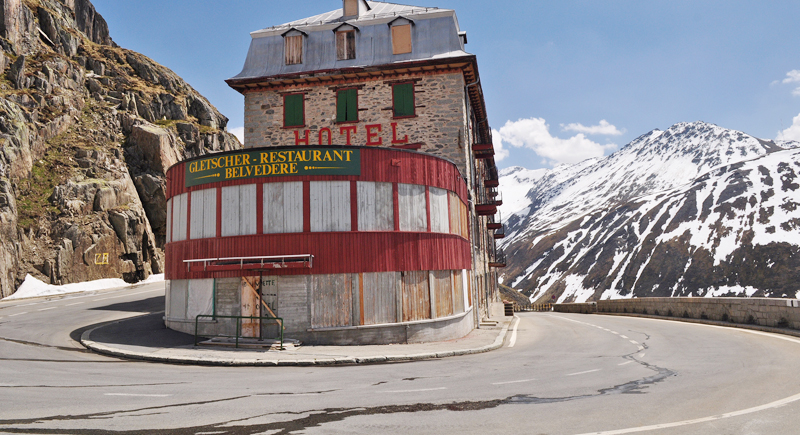
Image via Wikimedia Commons/lechoucas
Ironically, the hotel’s visibility increased as its viability declined. It appeared in the 1964 James Bond film “Goldfinger,” with Sean Connery racing past the building in an Aston Martin. The image of the hotel, with its dramatic curve, became iconic and was reproduced on postcards and across social media.
But fame did not translate into financial sustainability. Today, visitors still stop to photograph the stone façade and mansard roof against the sweeping alpine backdrop. Many sleep in campers in nearby parking areas rather than in historic pass hotels.
A Symbol of Changing Alpine Reality
The story of the Hotel Belvédère is not about one failure. It is about layers of change.
World wars disrupted tourism, then cars shortened stays. Infrastructure played its own part by redirecting traffic, and overall architectural tastes shifted. Regulations also intensified, and the glacier, the very reason for the hotel’s existence, retreated beyond sight.
What remains is a Belle Époque structure that once symbolized the optimism of Swiss mountain tourism. Its stone walls still catch the alpine light and its terrace still overlooks the bend in the road.
But the world that built it has long since moved on.