The Rare Place in Japan Where Snow Meets the Sea on the Sand
Along Japan’s western coastline, winter conditions sometimes create a rare sight with snow covering the sand while waves continue to roll in from the sea. Coastal monitoring data have documented this unusual overlap of heavy snowfall and an open shoreline.
Global attention surged after photographer Hisa shared an image of the phenomenon that drew roughly 658,829 likes on Instagram. The scene was captured within San’in Kaigan Geopark, a protected geological zone recognized internationally since 2010.
The phenomenon appears only under specific seasonal conditions and disappears quickly as temperatures rise.
Where This Rare Coastal Phenomenon Happens
The phenomenon occurs within the San’in Kaigan UNESCO Global Geopark, which spans coastal areas across Kyoto and Tottori Prefectures on Japan’s western coast, along the Sea of Japan. Key zones include Kyogamisaki Cape and the Hakuto Kaigan coast.
San’in Kaigan was designated a Japanese Geopark in December 2008. It later gained UNESCO Global Geopark recognition in October 2010, which placed it among internationally protected geological landscapes of scientific and environmental importance. Online posts sometimes mislabel viral images as Hokkaido locations, but in reality, this phenomenon is found in the San’in coastal region.
Snow Can Reach the Shoreline
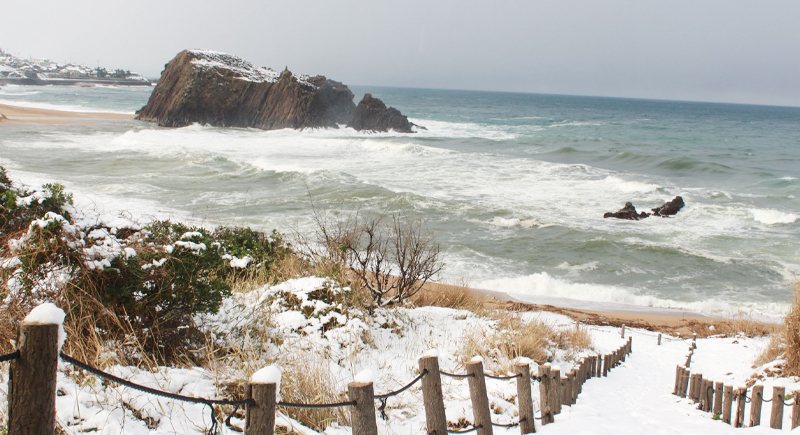
Image via Facebook/San’in Kaigan Geopark
Several natural factors combine to create the event. Winter storms moving across the Sea of Japan bring heavy snowfall to the coastal land. At the same time, the ocean surface usually stays liquid due to salt concentration and water movement. The combination allows snow to build up along the beach while waves continue rolling onto the sand.
The geopark landscape plays a role too. The coastline includes dunes, sandbars, and formations shaped by river flow and ancient volcanic activity. These features affect wind patterns and snow accumulation during the winter months. The result appears mainly between December and February, depending on yearly snowfall totals. Once seasonal temperatures rise or storms shift direction, the effect disappears quickly.
Why Viral Photos Changed Tourism Interest

Image via Canva/Pheelings Media
The image captured by Hisa helped introduce this coastal event to a global audience. Social media sharing amplified awareness beyond traditional travel channels, and part of the fascination stems from rarity. Sandy beaches rarely see heavy snowfall, and areas that receive snow near oceans often have rocky coastlines instead of sand.
Some beaches in the northeastern United States, including parts of New York and New Jersey, can occasionally show snow on the sand during cold winters, though the visual contrast tends to be less dramatic. San’in Kaigan remains unique because the snow can exist directly beside active waves while covering wide stretches of sand.
When Visitors Can See It
Timing depends heavily on winter weather patterns. January usually offers the highest chance, though late December and early February can still produce the effect. Visitors should expect strong coastal winds and freezing temperatures, even though the location is technically a beach environment.