The Mystery of the Creepy ‘Blood Falls’ in Antarctica
At the edge of Antarctica’s Taylor Glacier, a bright red stream pours out onto stark white ice, looking uncannily like blood. Known as Blood Falls, this phenomenon has unsettled explorers and puzzled scientists for more than a century. It completely defies expectations of what frozen landscapes should do.
A Discovery That Baffled Early Explorers
Blood Falls was first documented in 1911 by geologist Griffith Taylor during an Antarctic expedition. At the time, the red staining seemed impossible to explain. Antarctica was assumed to be biologically sparse and chemically simple, so the idea that liquid water—let alone vividly colored liquid—could emerge from a glacier raised immediate questions.
Early theories and researchers believed microscopic red algae might be responsible, similar to organisms that color snow pink in alpine regions. Others suggested iron-bearing minerals were staining the ice. For decades, none of these explanations fully held up.
The Hidden Water Beneath The Ice
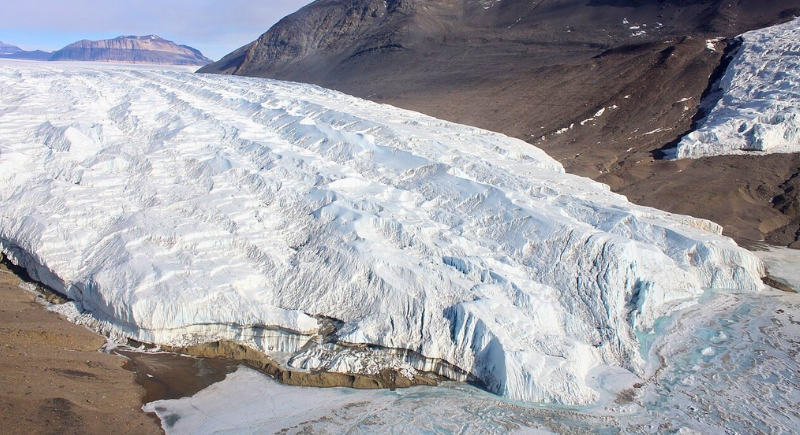
Image via Wikimedia Commons/Eli Duke
Modern technology finally revealed that Blood Falls is not a surface feature at all. Beneath Taylor Glacier, there’s a trapped reservoir of ancient saltwater, isolated from the surface for roughly one million years. Ground-penetrating radar studies showed networks of cracks and channels beneath the ice that allow this briny water to migrate outward.
The reason this water does not freeze, despite Antarctic temperatures well below 32°F (0°C), comes down to chemistry and pressure. The water is extremely salty, lowering its freezing point, and the immense pressure beneath the glacier further prevents solidification. As the water is forced upward, it eventually reaches the surface at the glacier’s snout.
Why The Water Turns Red Only After It Emerges
One of the strangest aspects of Blood Falls is that the water initially emerges clear. The dramatic color change occurs only after it comes into contact with air. This delayed reaction long confused scientists, especially since earlier tests found surprisingly little crystalline iron.
A breakthrough came in 2023, when researchers used transmission electron microscopy to examine the water at an extremely fine scale. Instead of large mineral grains, they found countless iron-rich nanospheres. These particles are thousands of times smaller than a human red blood cell. They are amorphous, meaning they lack the rigid crystal structure that standard mineral tests are designed to detect.
When the water reaches the surface and comes into contact with oxygen, the iron in these nanospheres oxidizes. This chemical reaction produces iron oxides and hydroxides, creating the deep red and rusty orange colors that give Blood Falls its unsettling appearance.
An Ecosystem Without Sunlight
Image via Getty Images/reisegraf
Even more surprising is that this subglacial water supports life. The briny reservoir hosts microbes that have survived for millennia without sunlight or fresh oxygen. These organisms rely on chemical reactions involving iron and sulfur to generate energy, a rare example of an ecosystem completely independent of photosynthesis.
This discovery has expanded scientists’ understanding of where life can exist. If microbes can thrive beneath Antarctic ice in salty, oxygen-poor water, similar life forms could potentially exist beneath the icy surfaces of Mars or Jupiter’s moon Europa.
Blood Falls Today
Blood Falls is no longer considered a mystery in the supernatural sense, but it remains scientifically remarkable. It demonstrates that glaciers are not inert blocks of ice; they can hide dynamic systems of liquid water, chemistry, and biology beneath their surfaces.
The phenomenon also highlights how easily nature can deceive the human eye.