The Most Architectural and Unique Train Stations Across Europe
Train stations in Europe aren’t just places you pass through. Some of them stop you in your tracks before you even check the platform. You walk in and notice the scale, the details, the history built into the walls. In a lot of cities, the station feels just as memorable as anything outside. This list looks at the ones where the design actually adds to the experience of being there.
Milano Centrale — Milan, Italy
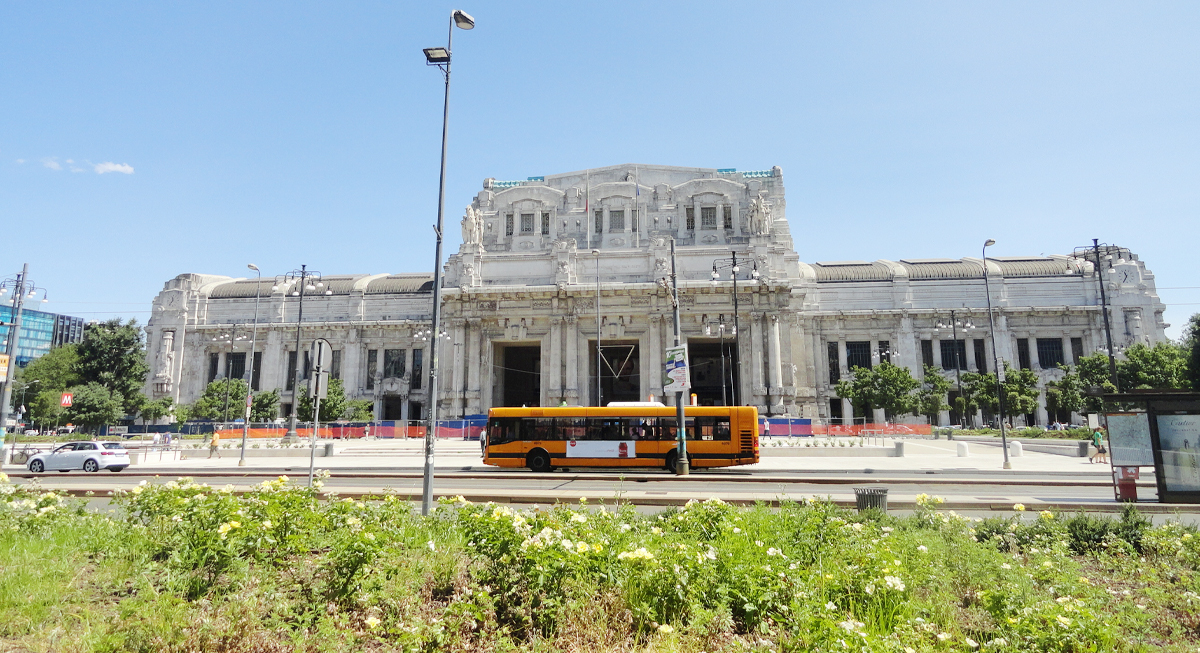
Image via Wikimedia Commons/l0da_ralta
Few stations in Europe match the sheer scale of Milano Centrale. Completed in 1931, the building stretches across more than 650 feet, with towering stone facades and heavy ornamentation that feel closer to a palace than a transport hub. Its design shifted during construction under Benito Mussolini, who pushed for a more imposing structure to project power.
Inside, marble floors, massive vaulted ceilings, and a 236-foot glass canopy reinforce that sense of magnitude. Beneath the grandeur, there is Platform 21, now a memorial marking the deportation of Jewish people during World War II, giving the station a historical weight that extends beyond its architecture.
Antwerpen-Centraal — Antwerp, Belgium
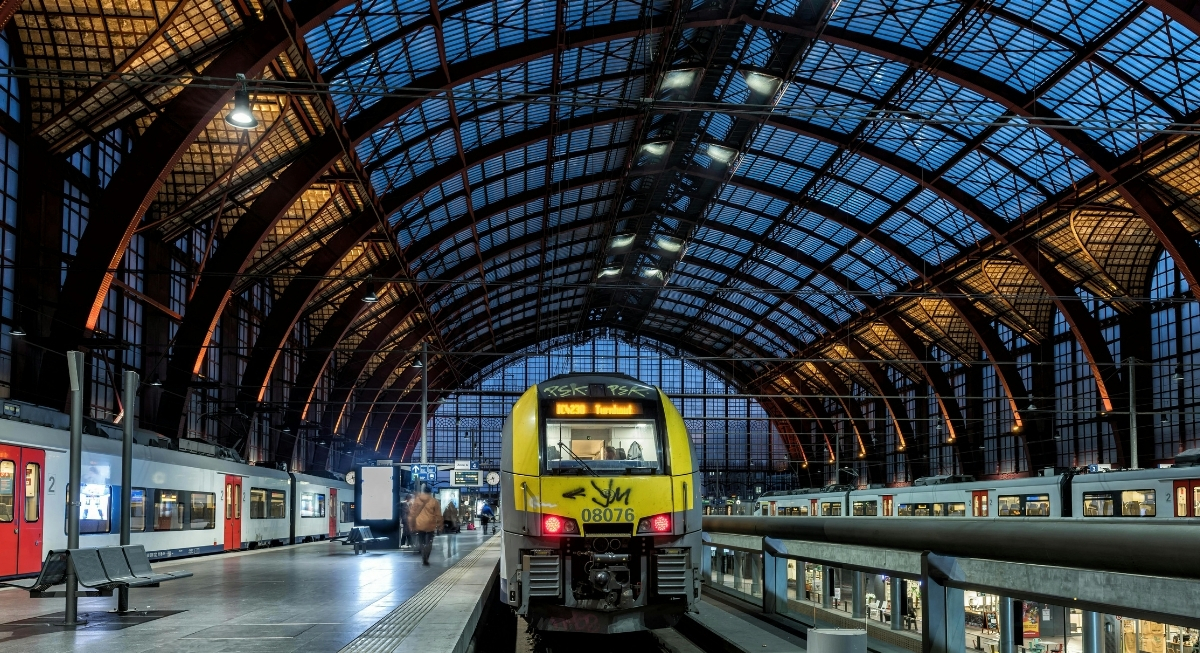
Image via Pexels/Wolfgang Weiser
Antwerpen-Centraal opened in 1905 and still feels more like a landmark than a station. The main hall is built on a grand scale, with a stone interior, a tall dome, and a wide staircase that draws you deeper inside. It’s the kind of place where you naturally slow down just to take it in.
The layout adds another layer. Trains run across three different levels, including high-speed lines that pass through tunnels beneath the original building. The historic structure stayed intact while the system expanded around it. That balance is what stands out. You get the weight and detail of the original design, along with a station that handles modern traffic without losing its character.
St. Pancras International — London, United Kingdom
The red-brick Gothic facade of St. Pancras stands out even in central London. As a 19th-century structure, it pairs ornate Victorian detailing with what was once the world’s largest single-span iron-and-glass roof. The station fell into decline in the mid-20th century and came close to demolition before being restored and reimagined as an international rail hub in 2007.
Today, high-speed trains connect London to cities like Paris and Amsterdam, while the interior balances historic structure with modern retail, restaurants, and even a five-star hotel built into the original complex.
Gare de Lyon — Paris, France
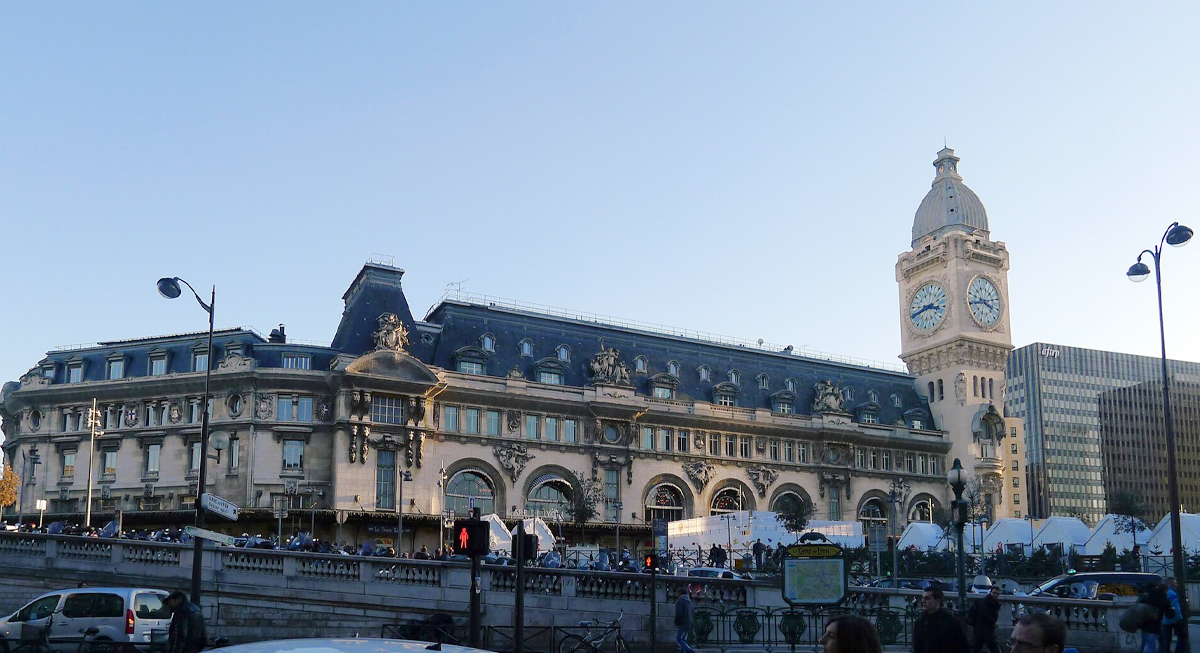
Image via Wikimedia Commons/Mbzt
Gare de Lyon stands out the moment you see it. The clock tower rises above the streets and makes it easy to spot from a distance. Inside, the space opens up into bright halls with painted murals that point toward destinations across southern France.
The station was built for the 1900 Paris Exposition, which explains why everything feels designed to impress from the start. The part people remember most is Le Train Bleu. It feels more like a historic dining room than a station restaurant, with chandeliers, gold detailing, and painted ceilings all around you.
Madrid Atocha — Madrid, Spain
Madrid Atocha brings together two very different ideas in one place. The original train hall keeps its arched steel-and-glass roof, but the space underneath was completely transformed into a large indoor garden filled with tropical plants.
The station expanded in the late 20th century, and the newer sections now handle high-speed rail traffic. That shift allowed the historic building to stay preserved, turning it into one of the most unusual station interiors in Europe.
São Bento — Porto, Portugal
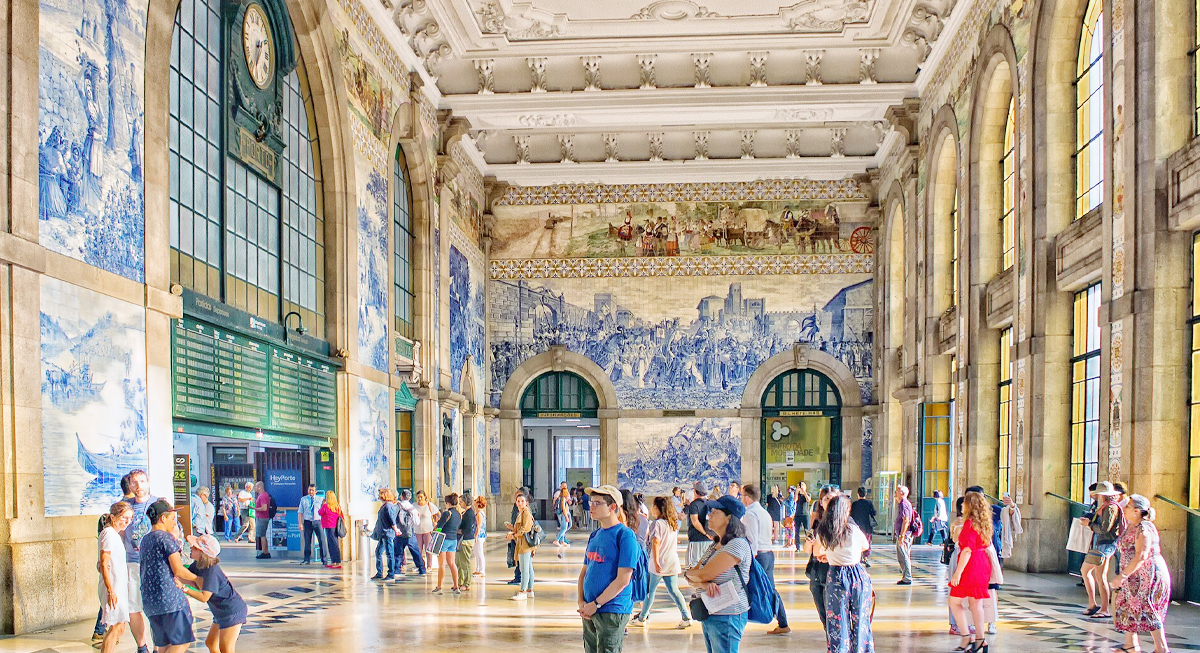
Image via Wikimedia Commons/Ray in Manila
São Bento looks fairly traditional from the outside, but the interior changes that completely. The main hall is covered in around 20,000 azulejo tiles by Jorge Colaço, showing historical events and everyday scenes from across Portugal.
The station was completed in 1916 on the site of a former monastery. It still functions as a working station, but many people come in just to look at the artwork rather than travel.
Liège-Guillemins — Liège, Belgium
Liège-Guillemins was designed by Santiago Calatrava, one of the most influential starchitects of the modern era, and finished in 2009. His work replaces traditional station design with a structure that emphasizes openness and movement.
It features a sweeping white steel framework and a vast glass canopy with no enclosing walls. The absence of solid boundaries creates a sense of continuity between the station and the city, while the structure’s repeating lines draw attention to light and geometry rather than ornament.
Amsterdam Centraal — Amsterdam, Netherlands
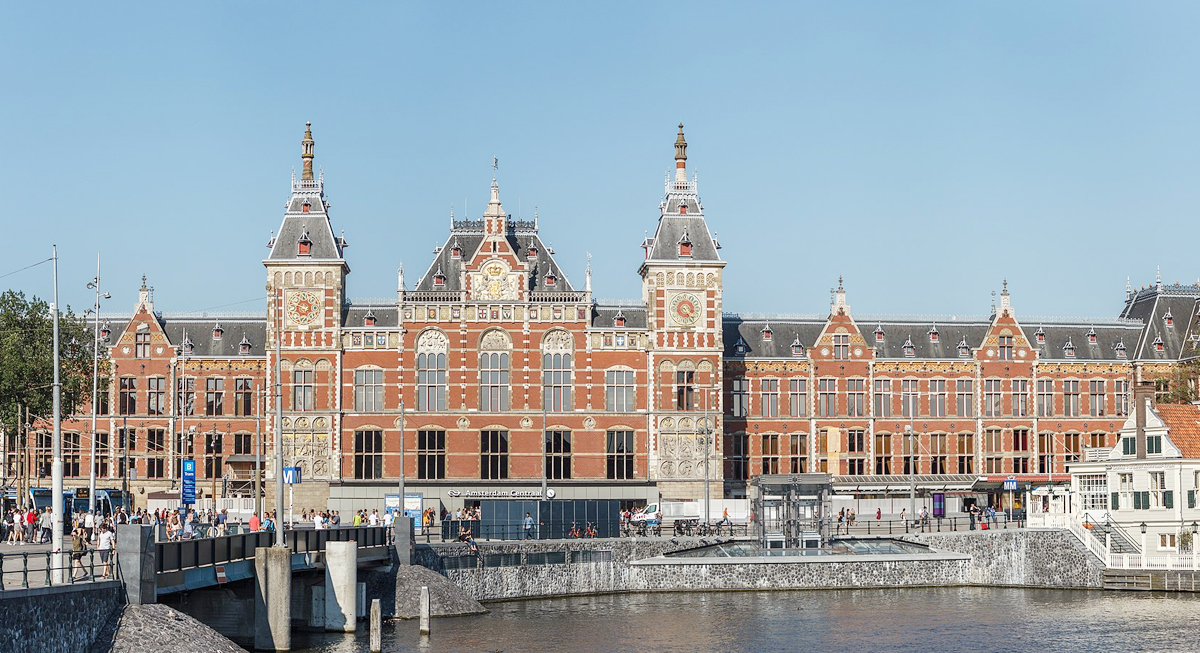
Image via Wikimedia Commons/Slaunger
Amsterdam Centraal looks like it belongs among the city’s historic landmarks, with its red-brick facade, towers, and decorative detailing. It was designed by Pierre Cuypers, the same architect behind the Rijksmuseum.
What sits beneath the surface is just as impressive: the station rests on 8,687 wooden piles driven into three artificial islands in the IJ River. That hidden foundation makes the entire structure possible and adds another layer to its architectural significance.
Helsinki Central Station — Helsinki, Finland
Helsinki Central Station was completed in 1919 and uses a simplified architectural style compared to earlier European stations. The granite facade is defined by four statues holding spherical lamps, known as the “lantern bearers,” which serve as the building’s most recognizable feature.
Inside, the layout focuses on function. Decorative elements are limited, but the design still matches the identity set by the exterior without adding unnecessary detail.
Arnhem Central — Arnhem, Netherlands
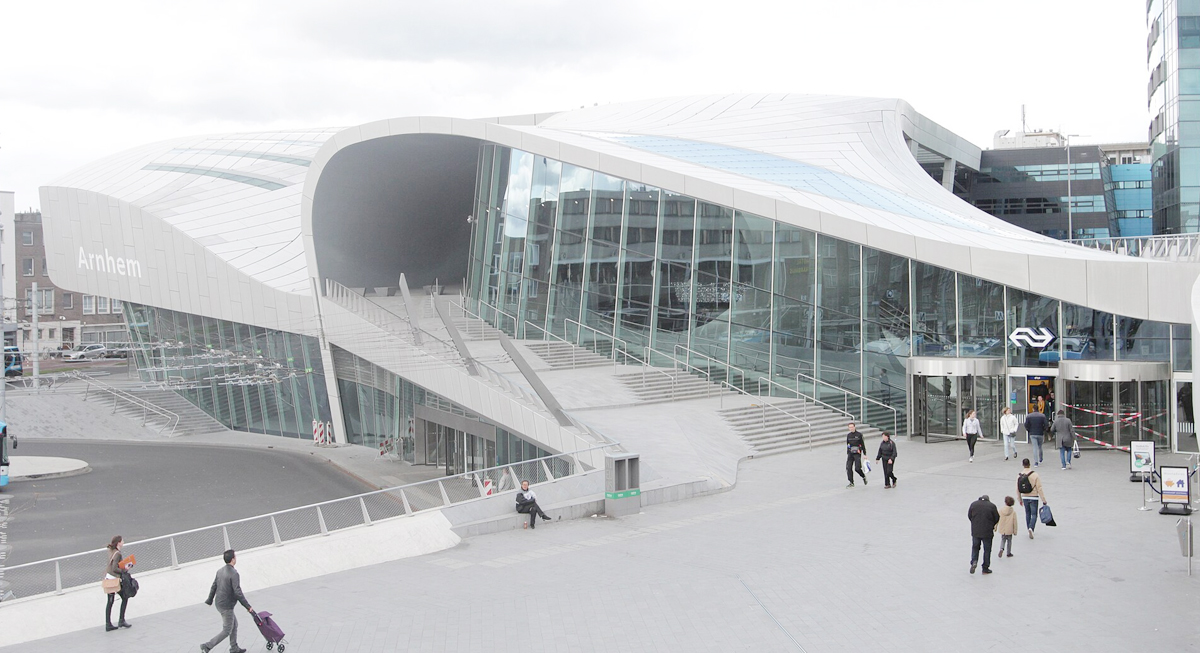
Image via Wikimedia Commons/JArnhem
Arnhem Central represents a completely different approach to station design. This one was fully constructed in 2015, and the building replaces rigid lines with continuous curves that guide movement through the space. Designed by UNStudio, it was constructed using techniques more commonly associated with shipbuilding, allowing for its fluid, sculptural form.
The layout connects trains, buses, and pedestrian routes in a single integrated structure, making the station function as both a transport hub and a gateway into the city.