Scientists Found a Place Where the Earth’s Layers Are Upside Down
Geology runs in order, as sediments pile up over time, with older material buried deeper and younger layers added on top. The sequence allows scientists to read Earth’s past like a timeline. It explains why certain fossils appear where they do and why energy companies trust subsurface maps when drilling miles below the surface.
However, in the North Sea, that rule does not apply. Detailed seismic surveys revealed vast mounds beneath the seabed that seemed reversed, and younger sands existed below much older material. The formations stretched several miles across, far larger than anything tied to small landslides or local disruptions.
What The Data Showed

Image via Canva/charliepix
The discovery came through seismic imaging, a technique that sends sound waves through rock and tracks how they bounce back. Density is important because heavy material reflects signals differently from lighter sediment. When analysts mapped the returns, large sections looked inverted. Sand layers that should rest near the top appeared buried, while older porous material showed up above them.
These structures earned a name; the sunken sand bodies became sinkites. The lighter slabs pushed upward and gained their own label as floatites. Together, they form the largest known example of stratigraphic inversion documented beneath an ocean basin.
How Layers Ended Up Flipped
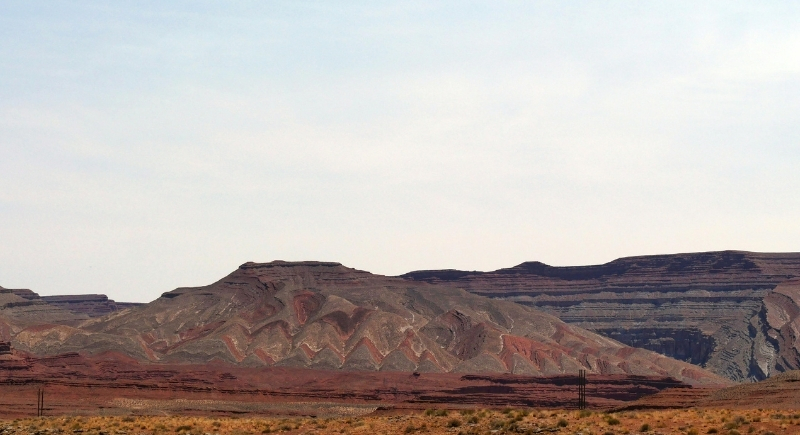
Image via pexels/Rino Adamo
The mechanism traces back millions of years to a period near the Miocene and Pliocene boundary around 5.3 million years ago. At that time, the region held a rigid, lightweight layer rich in microscopic marine fossils, and above it sat denser sand.
Seismic activity likely disrupted the balance. Shaking altered the pressure underground and loosened the sand. Once mobile, the heavier material pushed downward through fractures, forcing the lighter sediment upward, and gravity did the rest. Over long stretches of time, additional sediment settled across the area and smoothed the surface, hiding the rearrangement below.
Why Scientists Care

Image via Canva/Aflo Images
This is not a curiosity locked in the past. Subsurface structure controls how fluids move underground. Oil, gas, water, and injected carbon dioxide follow pathways shaped by density and sealing layers. An inverted stack behaves differently from a textbook one.
Understanding sinkites and floatites improves predictions about where fluids travel and where they stall. That matters for underground storage projects tied to carbon capture, where reliability depends on stable seals and accurate models.
The North Sea attracts scrutiny, and decades of oil and gas exploration have generated enormous libraries of seismic data. New energy plans add another aspect of attention, with wind projects aiming to deliver roughly 120 gigawatts of capacity by 2030 across northern Europe. Each survey sharpens the image beneath the seabed.
More data meant better resolution. Better resolution exposed patterns that earlier tools could not resolve. The inversion probably existed long before modern science could see it clearly.
What Comes Next
Researchers continue to test the interpretation against additional datasets and alternative models. What stands out is the scale. Small inversions appear in many places, tied to landslides or tectonic shifts. Entire fields of inverted layers beneath a major sea push the conversation further. They remind scientists that Earth’s crust, especially offshore, still holds surprises even in regions mapped for decades.