Portland’s Forest-Inspired Terminal Finally Reaches Its Peak in 2026
Portland International Airport has been under construction long enough that many travelers have only seen it in pieces. Work began in 2019, with the most visible upgrades opening in August 2024, but the final version is only now coming together in 2026. What used to feel like a maze of detours and temporary walkways is starting to look like a complete, finished space.
The Port of Portland kept the airport running while rebuilding it in phases, which stretched the process but avoided full closures. Construction picked up in 2020 and led to the launch of a new main terminal on August 14, 2024, with redesigned check-in areas, larger public spaces, and updated security. The remaining sections were rolled out in stages, with final openings taking place in 2026. The goal is to support long-term growth, with projections of around 35 million passengers a year by 2045.
A Better Flow From Security to Baggage Claim
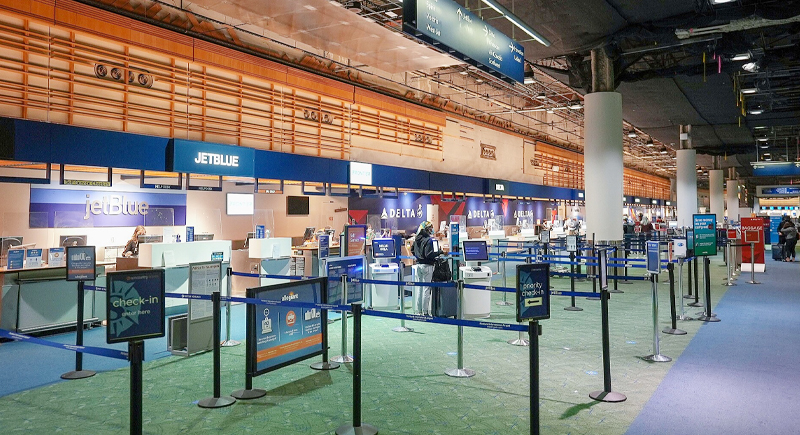
Image via Wikimedia Commons/Quintin Soloviev
One of the earliest upgrades tackled a common frustration. The new screening system allows passengers to keep items in their bags, reducing the stop-and-start routine at checkpoints. That change speeds up the process and reduces long lines without lowering safety standards. It’s one of the first things travelers notice after entering the terminal, and shapes how the rest of the airport now operates.
The most meaningful improvement comes at the end of the trip. After the 2024 opening, travelers still had to walk long distances from the gates to baggage claim. Everyone had to pass through a central exit point, creating congestion and adding extra time after landing.
Phase two removes that issue. New exits on the north and south ends of the terminal now lead directly to baggage claim through escalators. Instead of funneling through a single crowded area, passengers can depart from multiple points and reach their bags faster.
It Feels Like Portland the Moment You Walk In
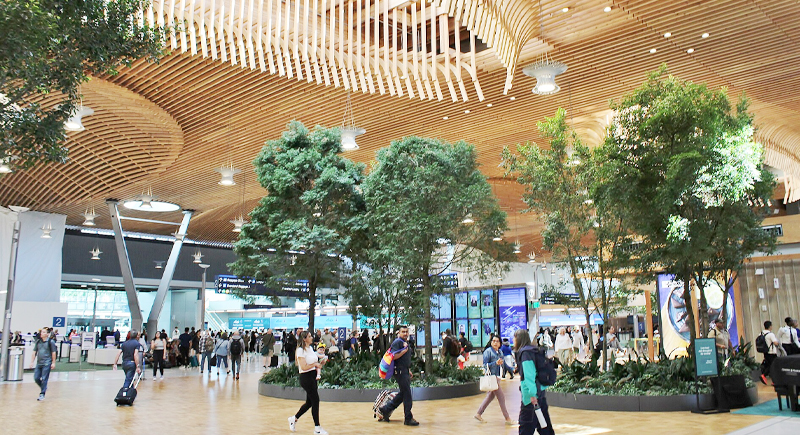
Image via Wikimedia Commons/SounderBruce
The design leans into the Pacific Northwest, and it shows up in ways travelers can see right away. The terminal features 72 live trees, wood-beamed ceilings, and indoor greenery throughout the space. Designers focused these elements around high-stress areas like ticketing and security to ease the experience during the busiest parts of a trip. The idea was to bring the region indoors so the airport feels connected to its surroundings rather than cut off from them.
As construction walls come down, the terminal is filling out with local businesses rather than generic chains. Around 300,000 square feet of new space includes 14 additional storefronts, all tied to local brands. Shops and restaurants such as Columbia Sportswear, Powell’s Books, Portland Coffee Roasters, and Kure Superfoods are expanding or opening new locations. A rotating pop-up program also gives smaller businesses a chance to test out airport locations before committing long-term.
Art And Layout Work Together
Art plays an important role in the final phase of the project. A 55-foot mosaic by Lakota artist Dyani White Hawk stands out as one of several large installations across the terminal. Additional works by Indigenous artists from across the Pacific Northwest are also being added as the project moves forward.
At the same time, the layout has been simplified. New direct routes connect concourses to exits, and added escalators and seating areas make it easier to move through the terminal without confusion. Even meeting arriving passengers is more straightforward, with new north and south exit points replacing a single crowded pickup area.