It Would Take You 100 Days to See Everything in the Louvre
Louvre Museum is more than a place to look at paintings. It began as a royal palace, evolved into a symbol of French history, and today stands as the largest art museum in the world. If you decided to see every single work currently on display, you would need about 100 days. That number sounds exaggerated, but it comes down to straightforward math.
The Louvre displays roughly 35,000 works of art at any given time. If you spent just 30 seconds looking at each one, it would take you around 291 hours to see them all. If you visited for three hours a day, that adds up to approximately 97 days. Round it up, and you land at 100. And that only covers what is currently on display.
The Scale Is Hard to Grasp
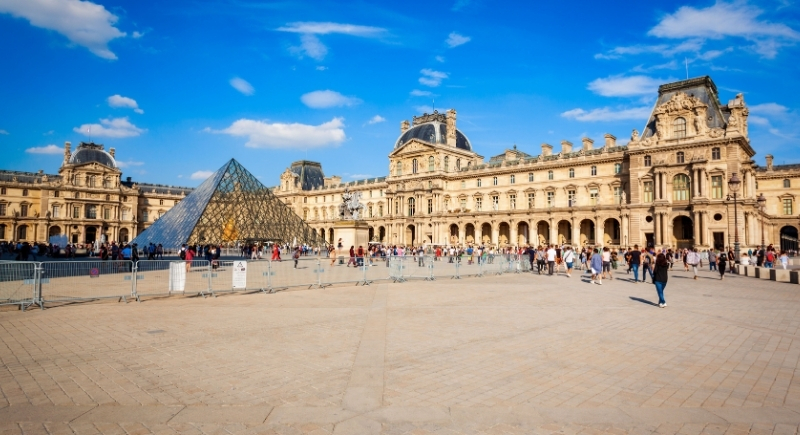
Image via Canva/Andrey
The Louvre owns more than 380,000 objects. Only a fraction of them are exhibited at once. The museum spans 72,735 square meters of exhibition space, which equals nearly 783,000 square feet. That is roughly 15 acres of galleries spread across three massive wings: Denon, Sully, and Richelieu.
Walking from one end of the museum to the other is not a casual stroll. It is a deliberate trek through centuries of human history. Egyptian antiquities, Mesopotamian reliefs, Greek sculptures, Renaissance paintings, Islamic art, French decorative arts, and Napoleonic apartments all live under one roof.
It is less a museum and more a city of art.
Most Visitors See About 1%
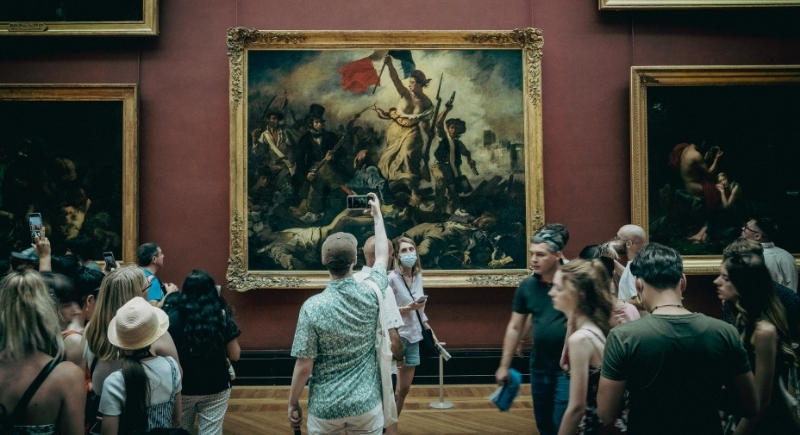
Image via Pexels/Wellington Silva
Now here is where the 100-day statistic becomes even more revealing. Most visitors spend between two and four hours inside the Louvre. Let’s assume three hours, which is generous for a first-time visitor navigating crowds.
Three hours in a museum equals 10,800 seconds. If you gave each artwork just 30 seconds, you would manage to see about 360 pieces in that time. Compared to the roughly 35,000 works on display, that is barely a dent. On average, a typical visit covers only around 1% of what the museum is actually showing.
And that does not account for walking time, pausing for photos, navigating security, or stopping for a coffee break. In reality, the percentage is probably even smaller.
The Museum Was Never Designed for Speed
Part of what makes the Louvre so vast is its architecture. It began as a fortress in 1190 under King Philip II. In the 16th century, Francis I transformed it into a royal palace. It officially opened as a public museum in 1793 during the French Revolution.
Unlike many modern museums, which are built with a clear, efficient layout, the Louvre expanded gradually over centuries. Its Renaissance courtyards, medieval foundations, and 19th-century wings were never planned as part of one smooth visitor route. They were designed for royalty, political power, and ceremony. That layered history still shapes how the building feels and functions today.
The museum is divided into three main wings:
Denon, home to the “Mona Lisa,” the “Winged Victory of Samothrace,” and large-scale French paintings like “Liberty Leading the People.”Sully, where visitors find the “Venus de Milo,” Egyptian antiquities, and the medieval Louvre foundationsRichelieu, which includes Mesopotamian artifacts, Dutch masters, and the lavish Napoleon III Apartments
Even reaching one specific artwork can involve navigating multiple staircases, long corridors, and entire wings.
The Mona Lisa Effect
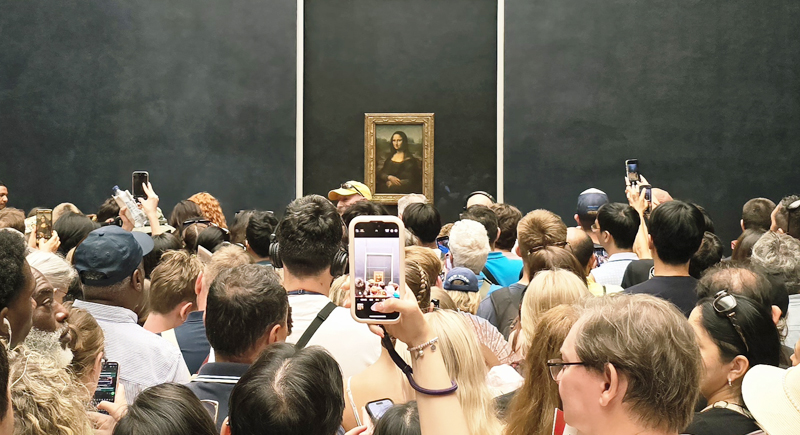
Image via Wikimedia Commons/Pedemann
Most visitors cluster in the Denon Wing, specifically around Leonardo da Vinci’s “Mona Lisa.” The painting draws millions of visitors each year, and the crowd around it can stretch deep into the gallery.
That concentration of traffic creates a distorted experience. While thousands gather in one room, entire sections of Greek antiquities or Northern European painting can remain relatively quiet.
The Louvre’s annual attendance often reaches around 9 to 10 million visitors in a typical year. Yet even with that number, the vast majority of the museum remains unseen by most guests. The paradox is clear: the world’s most visited museum is still largely unexplored by those who enter it.
Even a Full Day Is Just a Slice
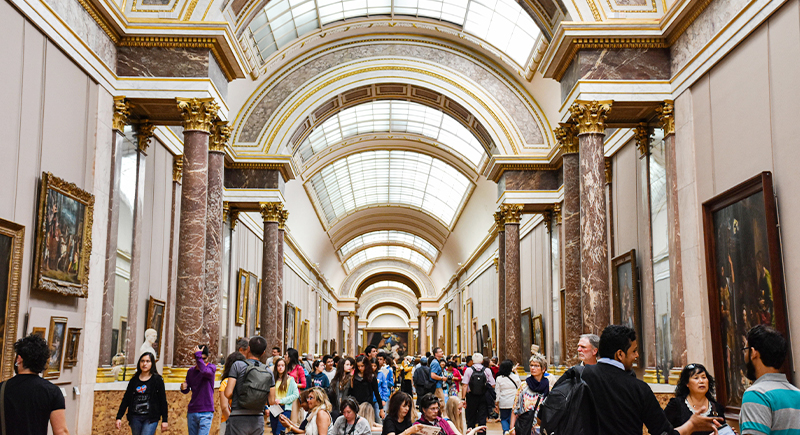
Image via Pexels/Una Laurencic
Suppose you committed to a full eight-hour day in the museum. At 30 seconds per artwork, you could theoretically view about 960 pieces in that time, which still represents less than 3% of what is displayed.
And no one actually views art at a consistent 30-second pace. Some works deserve minutes. Others invite study. Large canvases like “The Coronation of Napoleon” or “The Raft of the Medusa” demand attention.
Sculptures such as the “Winged Victory of Samothrace” reward slow observation from multiple angles.
The 100-day estimate is conservative because it assumes rapid, surface-level viewing.
What the Number Really Means
Saying it would take 100 days to see everything is not meant to scare anyone off. It simply resets your expectations. A visit to the Louvre is not about checking every box. It is about deciding what matters most to you that day.
You do not complete the Louvre. You move through it. You pick a route across centuries of human creativity and accept that most of it will stay unseen, at least for now. The scale is bigger than any single visit.
You might spend three hours and focus on a few iconic works. Meanwhile, thousands of other pieces remain across its 72,735 square meters of gallery space, drawn from a collection of more than 380,000 objects.
Some places are designed to be finished. Others are meant to be returned to.