Even the British Navy Could Not Conquer This Invincible Fort
For nearly four centuries, a massive stone fortress stood just off India’s western coast and refused to bend to any empire that came for it. The Marathas launched 13 separate attempts to capture it. The Mughals circled and strategized. The Portuguese watched it closely. Later, even the British Navy brought its ships and firepower to the shoreline.
Yet every assault ended the same way. The walls held firm, the cannons roared in reply, and the rulers inside never surrendered control. This is the story of Janjira Fort, a sea stronghold that simply would not fall.
The African Dynasty That Took Control

Image via Wikimedia Commons/flickr
Janjira is on an island near Murud in the present-day Raigad district, Maharashtra. Its rise began in 1490 A.D., when Abyssinian commanders, known locally as the Sidis, wrested control of the fort area from a Koli ruler. Over time, they established a small but powerful state along the Konkan coast.
The Sidis traced their ancestry to East Africa, including Ethiopia, Somalia, and later Zanzibar. Many arrived in India as sailors, soldiers, or enslaved people within Indian Ocean trade networks. In the Deccan, several rose through the ranks of the military. One of the most famous among them was Malik Ambar.
In 1567 A.D., Malik Ambar, serving the Nizam Shahi rulers of Ahmadnagar, commissioned the massive stone fortification that still stands. He replaced earlier wooden defenses with thick basalt walls designed to withstand naval assault. The result was a maritime fortress built for survival.
Built To Withstand The Sea And War
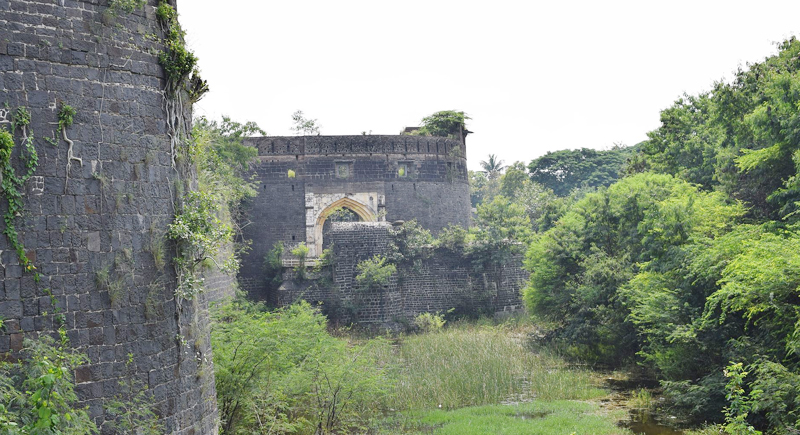
Image via Wikimedia Commons/SafarNama
Janjira’s design explains its record. The fort spreads across roughly 22 acres and rises about 40 feet above sea level. Instead of a square layout common to many inland forts, it follows an oval shape. Nineteen bastions line its perimeter, and at its height, around 500 cannons were mounted across these defensive points. Several large cannons remain today, including the well-known Kalal Bangadi.
Inside the walls stand the ruins of a palace, a mosque, and royal baths. A deep freshwater well sits at the center, which is vital. Despite being surrounded by saltwater, it supplied sweet drinking water, allowing the fort to withstand long sieges.
Approaching Janjira by sea posed a serious challenge. Waves crashed against its outer walls, and narrow landing points made large-scale invasion difficult. Any attacking navy had to deal with rough coastal waters before even reaching the gates.
Shivaji Tried, And So Did The British

Image via Wikimedia Commons/Chinmaya Panda
Chhatrapati Shivaji, founder of the Maratha Empire, recognized Janjira’s strategic value. Controlling it meant controlling a key stretch of the Konkan coast. Historical records note that he attempted to capture the fort 13 times, but each effort failed.
His son, Sambhaji, also sought control. At one point, he reportedly attempted an underwater strategy to breach the defenses. That effort collapsed. Shivaji then built a counter-fort across the bay known as Padmadurg, sometimes called Kasa Fort, to challenge Janjira’s dominance. Even that did not dislodge the Sidis.
The Mughals and the Portuguese also engaged with the region’s power struggles. Later, during the expansion of British influence in India, the British Navy confronted coastal strongholds across western India. Janjira remained outside their control. The Sidis maintained autonomy through shifting alliances and naval skill. The state of Janjira remained under Sidi rule until India’s independence in 1947, when the princely states merged into the Indian Union. The fort did not fall in battle, but transitioned through politics.
A Lasting Legacy
Families connected to the Sidi rulers lived within Janjira Fort until 1972. Today, the structure still rises above the Arabian Sea, largely intact despite centuries of waves and warfare.
Its story reshapes common assumptions about power in early modern India. An African-descended dynasty ruled a coastal state in Maharashtra for nearly 400 years. Major regional empires failed to conquer their sea fort. Even the British Navy could not break its hold.