A South Korean Miracle Opens the Sea Twice a Year for Just One Hour
Most days, the sea off South Korea’s coast looks no different from anywhere else. Then, a few times each year, something unusual happens. For about an hour, the water pulls back far enough to reveal a narrow path between the islands, and people step out onto what is usually the ocean floor.
This event, known as the Jindo Sea Parting Festival, is short and easy to miss if you don’t time it right. The shift is tied to predictable tidal patterns, so locals and visitors know exactly when to show up. For that brief window, the sea opens up, and you can walk across before the water returns and covers the path again.
The One-Hour Window Everyone Waits For
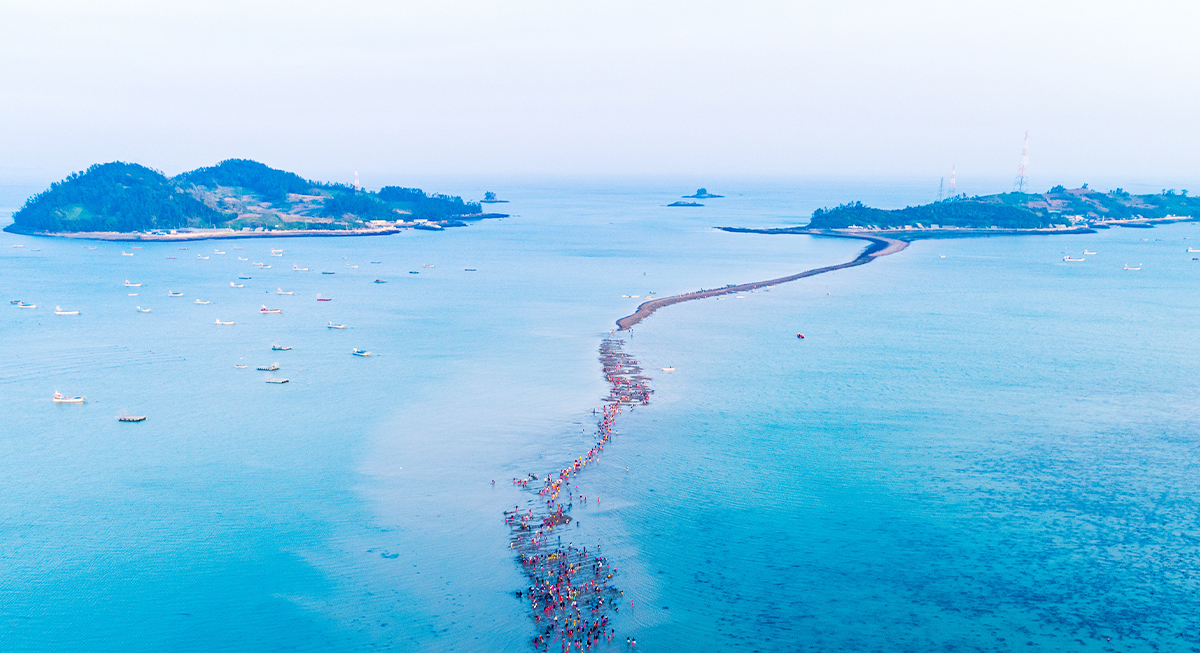
Image via iStockphoto/snowtigerman
The event happens between Jindo and Modo islands. When the tide hits its lowest point, a narrow path stretching nearly 3 kilometers emerges from the water. It’s not a slow reveal over the course of a day; the window when the path is fully walkable is incredibly tight, usually lasting about an hour.
Thousands of people show up early, standing on the shore with their boots on, just watching the waterline. You can see the anticipation in the crowd as patches of wet sand and rock start to link up. Once the path is clear, there’s a bit of a rush.
It’s Always Been There
Image via Getty Images/liliportfolio
The path isn’t something that appears out of nowhere. It’s always there, sitting just beneath the surface. For most of the year, it stays hidden under the water, so you’d never notice it even if you were standing right above it.
What actually changes is the sea level. During those short windows, the tide drops much lower than usual, and the water pulls back enough to reveal the raised strip of seabed connecting the islands. It’s less about land showing up and more about the ocean briefly stepping aside.
The Science That Makes It Work
There’s a logical explanation for why this happens. It’s caused by tidal harmonics, essentially a perfect storm of gravitational pulls from the moon and sun that result in an extremely low tide. Because of the specific shape of the coastline around Jindo, the local coastline and seabed shape amplify the effects of the low tide.
Because this is based on planetary alignment, it’s entirely predictable. Scientists can pinpoint exactly when the “miracle” will happen, which is why the festival dates are set well in advance. Once the gravitational pull shifts even slightly, the water rolls back in just as smoothly as it left.
Why People Call It A Miracle

Image via Getty Images/elinedesignservices
Even if you understand the physics of it, standing in the middle of the sea with water on both sides feels pretty heavy. That’s why it earned the nickname “the Korean Moses Miracle” back in the 70s.
Local tradition adds another layer to the experience. Legend says an elderly woman named Grandma Bbong was left behind on Jindo when her family fled to Modo to escape tigers. She prayed to the Sea Spirit to help her see them again, and the water parted to let her cross.