A New Sleeper Train Plans to Connect 100 European Cities With Private Rooms
Europe’s night train revival is about to take a decisive turn. A Berlin-based startup called Nox Mobility has revealed plans for an all-new overnight rail network built entirely around private rooms, with the long-term ambition of linking more than 100 cities across the continent.
If the timeline holds, the first Nox sleeper trains will begin operating in 2027. By 2035, the company aims to run a Europe-wide network designed to function as a true alternative to short-haul flights—one that prioritizes privacy, sleep, and city-center-to-city-center travel.
Designed Around Privacy
Traditional European night trains often rely on shared couchettes, where solo travelers frequently end up sleeping alongside strangers. Nox is deliberately rejecting that model. Every cabin on its trains will be private, available as either a single or double room, with no shared berths.
The company refers to these cabins as “rooms,” and the distinction is intentional. Each room is planned to function as a compact, self-contained space rather than a simple sleeping bunk.
According to Nox, all configurations will include two-meter-long beds, armchairs, tables large enough for eating or working, and dedicated storage. Some room types will also feature panoramic windows.
Three room layouts are planned, including loft-style rooms with elevated beds and double rooms where the bed converts into seating. The goal is to make overnight rail travel feel closer to a hotel stay than a transport compromise.
Prices Meant to Compete With Flying

Image via Getty Images/JackF
Affordability is central to the pitch. Nox says it intends to price its sleeper services competitively with short-haul flights. Current projections suggest fares starting around €79 ($92.15) for single rooms and €149 ($173.79) for doubles, depending on route and demand.
The pricing strategy is designed to remove one of the biggest barriers that has limited night train adoption in recent years. While sleeper services are often praised for comfort and sustainability, they can be more expensive than budget flights. Nox is betting that private rooms at flight-comparable prices can shift traveler behavior.
A Network Built at Continental Scale
Unlike boutique night train operators focused on a handful of flagship routes, Nox is thinking in network terms. The company argues that sleeper trains only make sense when travelers can reliably find an overnight rail option for most short-haul journeys.
Its long-term plan calls for connections between major European hubs, including Stockholm, Berlin, Paris, Amsterdam, Rome, Barcelona, Milan, Vienna, and Budapest, among many others. The idea is to create a dense mesh that mirrors the logic of airline networks—overnight departures, early-morning arrivals, and consistent availability.
By running trains overnight, Nox also emphasizes the practical benefit of saving daytime hours. Travelers board in the evening, sleep through the journey, and arrive the next morning in the city center, thus avoiding airports, transfers, and hotel check-in delays.
Sustainability and Business Travel in Focus
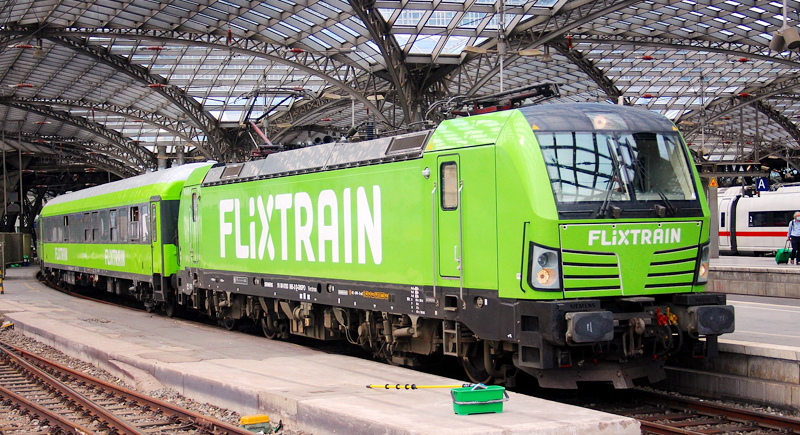
Image via Wikimedia Commons/Superalbs
Environmental positioning also plays a major role in Nox’s strategy. Sleeper trains are widely regarded as far less carbon-intensive than short-haul flights, particularly within Europe. Nox explicitly frames its service as a way to reduce aviation emissions without sacrificing convenience or comfort.
The company is also targeting business travelers, a segment that has been slower to return to overnight rail. Private rooms, onboard workspaces, and planned partnerships with hotels for early check-ins are intended to make sleeper trains viable for corporate travel.
Nox has highlighted ESG targets, productivity, and traveler well-being as key reasons companies might shift employees from planes to night trains. The startup was founded by Thibault Constant, known online as “Simply Railway,” who has documented hundreds of night train journeys around the world, and Janek Smalla, a co-founder of FlixTrain.
Together, they bring both operational experience and deep familiarity with the shortcomings of existing sleeper services.
The company states that it has consulted extensively with frequent travelers, travel agencies, and businesses to shape the design and service model ahead of its launch. Financing rounds and regulatory approvals are still underway, but cabin designs and network planning are already well advanced.
A Different Vision for European Travel
If Nox succeeds, it could help redefine how Europeans move between cities at medium distances. Instead of choosing between budget flights or daytime rail, travelers would have a third option of private overnight rooms that combine transport, accommodation, and rest in a single experience.
With a planned launch in 2027 and an ambitious expansion path through the next decade, Nox Mobility is positioning itself as a modern replacement for short-haul air travel.