The World’s Largest Gold Vault in New York Holds $850 Billion Underground
Beneath Lower Manhattan, the Federal Reserve Bank of New York operates the world’s largest gold vault. It’s located about 80 feet below street level and holds more than 6,300 metric tons of gold belonging primarily to foreign governments and central banks. At current market prices, the gold stored there is valued at roughly $800 to $850 billion, which makes it the single largest known concentration of monetary gold in one location.
The Largest Gold Repository on Earth
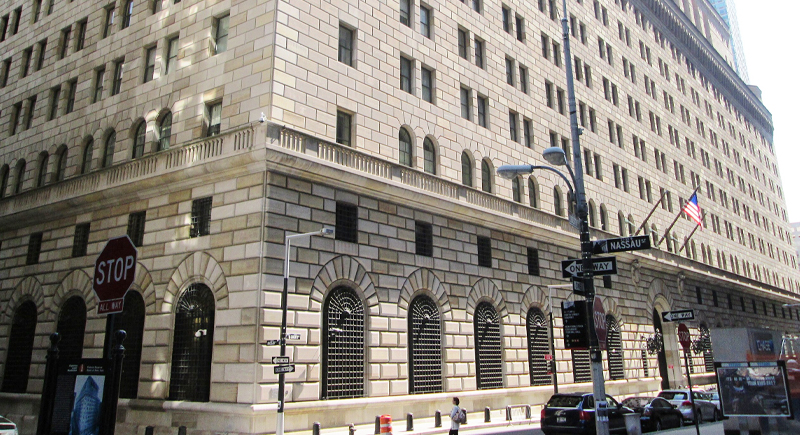
Image via Wikimedia Commons/Beyond My Ken
The gold vault at the Federal Reserve Bank of New York is widely recognized as the world’s largest known depository of monetary gold. According to the most recent disclosures, it contains approximately 507,000 gold bars, weighing a combined 6,331 metric tons. No other publicly acknowledged facility holds more sovereign gold in a single location.
The vault was built in the early 1920s as part of the bank’s original construction and was deliberately placed deep below street level. At 80 feet down, 50 feet below sea level, it rests directly on Manhattan’s solid bedrock, which is the only structure capable of supporting the immense weight.
Each standard gold bar weighs about 400 troy ounces, or roughly 27 pounds, meaning the vault supports tens of millions of pounds of metal.
What the Gold Is Actually Worth

Image via Canva/This Design
The Federal Reserve assigns the gold a fixed “book value” of $42.2222 per troy ounce for accounting purposes, a figure frozen in time since the end of the gold standard. The number dramatically understates reality.
At modern market prices, which hover around $4,000 per troy ounce, the gold stored beneath the New York Fed is worth approximately $850 billion. This valuation places the vault’s contents on par with the annual GDP of a mid-sized nation.
The Fed Does Not Own the Gold
One of the most common misconceptions about the vault is ownership. The Federal Reserve Bank of New York does not own the gold stored inside; it only acts as a custodian.
The gold belongs to account holders, including the U.S. Treasury, foreign governments, central banks, and international organizations such as the International Monetary Fund. Private individuals, corporations, and even billionaires are not permitted to store gold there. This is a sovereign facility designed for nations.
Each account holder’s gold is stored separately. The vault contains 122 individual compartments, with each compartment assigned to a single owner. Smaller deposits are placed on clearly numbered shelves inside a shared “library” compartment, still fully segregated and tracked.
Why So Many Countries Store Gold in New York
Much of the gold arrived during and after World War II, when European nations sought a secure location far from conflict zones. The United States—and New York in particular—offered political stability, geographic distance from war, and a rapidly growing financial infrastructure.
Holdings peaked in 1973, shortly after the U.S. formally ended dollar convertibility into gold. At that point, the vault contained more than 12,000 metric tons of gold. Although totals have declined since then due to repatriation and changing reserve strategies, the New York Fed vault remains unmatched in scale.
Storing gold in a single central location also enables countries to transfer ownership without physically relocating the bars. A transfer between nations can be completed by shifting bars from one compartment to another inside the vault, for a modest handling fee of about $2 per bar.
Inside the Vault’s Security System
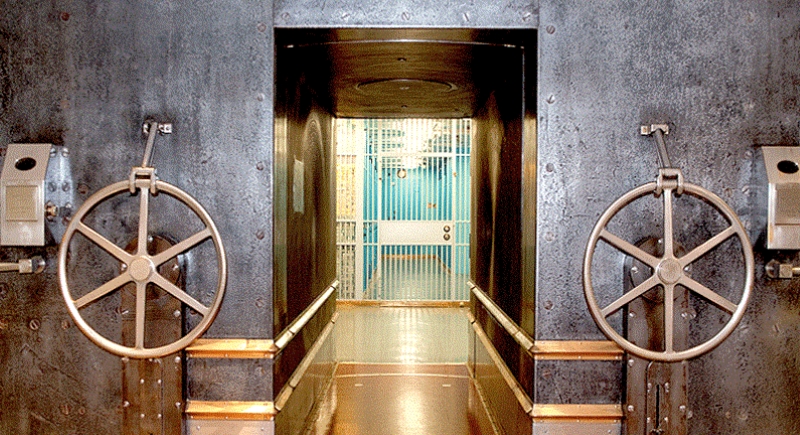
Image via Wikimedia Commons/Unknown
The only entrance to the vault is protected by a 90-ton steel cylinder embedded within a 140-ton steel and concrete frame. When closed, it forms an airtight and watertight seal. Once locked, steel rods are inserted, and time clocks engage, preventing entry until the next business day.
Security goes far beyond the door. Thick steel-reinforced concrete walls surround the vault, and movement inside is monitored continuously by cameras and motion sensors. Every time gold is handled, three people must be present: two vault staff members and one internal auditor. Even routine maintenance, such as changing a light bulb, requires this control group.
The vault is also protected by armed Federal Reserve police and the broader security systems of the building itself.
A Strategic Reserve
Unlike currency, gold bars inside the vault are treated as non-fungible. Each bar is individually weighed, inspected, and recorded upon deposit. Details such as refiner, purity, melt number, and shape are logged into official records.
When an account holder withdraws gold, they receive the exact same bars they deposited—not equivalent replacements. This level of precision is one reason the New York Fed remains trusted as a global gold custodian.