The Most Aesthetic Museum in Korea Is Dedicated Completely to Sound
A museum in Seoul opened in June 2023 with 11,000 square meters of space, seven floors, and a collection dedicated entirely to sound technology. In 2025, Prix Versailles named it one of the World’s Most Beautiful Museums.
It was founded by Michael Chung, the creator of Silbatone Acoustics, in memory of his father. The architect behind it is Kengo Kuma, and the name is Audeum. That combination explains why design lovers, music fans, and curious travelers keep talking about it.
A Building That Looks Like Music
The Audeum is in Seoul’s Seocho-gu District, positioned to face the Cheonggye mountains while remaining close to the city center. The exterior makes the first statement; more than 20,000 aluminum tubes wrap the façade at different lengths. They filter sunlight throughout the day, changing the building’s surface as the light shifts.
Kengo Kuma designed the structure to reflect patterns found in nature. The irregular spacing of the tubes creates a forest-like effect often compared to komorebi, the Japanese term for light passing through trees. Kenya Hara, who handled the museum’s art direction and signage, described the suspended pipes as music paused in midair.
Architecture Built for Listening
At Audeum in Seoul, the experience begins before any sound plays. A narrow entrance clad in rough natural stone pulls you inward. The surface changes how sound travels. As you move deeper inside, hard finishes shift to warmer materials. The transition feels deliberate and physical.
Alaska cypress covers key interior sections. Architect Kengo Kuma calls the method “wood drapery.” He selected the wood for its acoustic quality and subtle scent. The building functions as part of the exhibition. Kuma believes future healing will rely less on sight and more on hearing, and this museum expresses that idea through its materials and layout.
A Timeline of Sound Innovation
The collection focuses on the evolution of audio reproduction. The inaugural exhibition, titled “Jung Eum: In Search of Sound,” explores the development of high-fidelity technology.
Rare Edison phonographs appear alongside vacuum tube amplifiers that helped define early home audio systems. Western Electric’s 12-A and 13-A sound systems, which played a major role in introducing synchronized sound to cinema in the late 1920s, are part of the display. These systems contributed to the shift that ended the silent film era.
The museum traces how engineers pursued clearer sound, stronger amplification, and greater precision. Each object marks a technical leap that changed how people consumed music and film. Michael Chung’s background in high-end audio explains the depth of the collection. Silbatone Acoustics has long been associated with rare vintage equipment, and that expertise shapes the museum’s curatorial focus.
Why It Feels Different
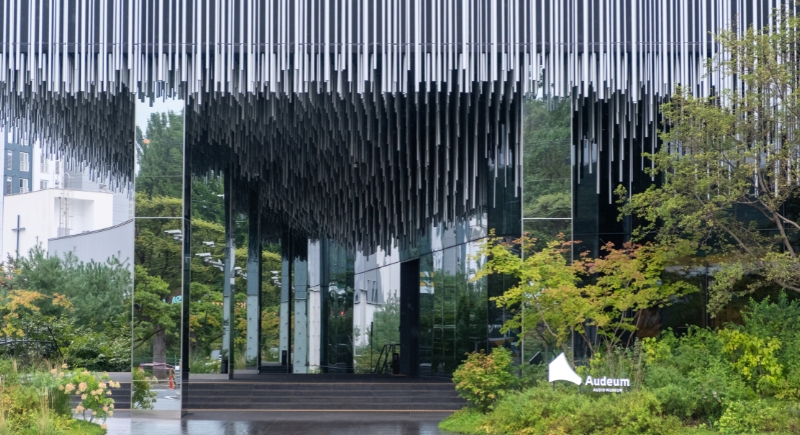
Image via iStockphoto/moomusician
Audeum stands apart because it centers listening rather than display. Its position away from Seoul’s most crowded zones reduces outside noise, which supports the museum’s acoustic focus. Visitors move through rooms engineered to manage echo, resonance, and vibration with precision.
In 2025, Prix Versailles recognized the museum for architectural excellence. The award acknowledged how closely the structure aligns with its purpose. This is not a space built to showcase objects alone. It is designed to shape how sound is experienced.